
Effective ASL training for healthcare workers enhances clinical outcomes by equipping providers with fundamental communication tools and cultural awareness to engage directly with Deaf and hard of hearing patients. These programs supplement professional interpreters by allowing medical staff to navigate routine interactions and reduce patient anxiety through improved accessibility.
Imagine the high stakes of a triage room where every second counts, yet a communication wall stands between you and your patient. Relying solely on the arrival of an interpreter often leads to critical delays and heightened patient anxiety during emergencies. While professional interpreters are essential for complex medical dialogue, healthcare providers need immediate tools to bridge the initial gap. This clinical necessity goes beyond simple vocabulary; it is about patient safety and establishing trust from the very first interaction. In this guide, we will examine how ASL training empowers medical teams to navigate the patient provider triad effectively. You will learn the importance of Deaf etiquette, practical skills tailored to specific clinical roles, and why understanding Deaf culture is fundamental to delivering equitable care. We also highlight how live online training provides the flexibility busy healthcare teams require to master these vital communication skills.
The Communication Gap in Clinical Settings

Precision is the foundagtion of effective medicine. In a clinical environment, the ability to exchange information rapidly and accurately can be the difference between a successful recovery and a medical crisis. For the Deaf and hard of hearing community, this exchange is often compromised by systemic hurdles. SignHealth data indicates that communication barriers are a primary cause of poorer health outcomes, frequently leading to misdiagnosis and preventable illnesses. These are not just inconveniences; they are significant risks to patient safety that stem directly from a lack of accessible dialogue.
While hiring a certified interpreter is a legal and ethical mandate under the Americans with Disabilities Act, there is a critical window of time where care often breaks down. This gap exists between the moment a patient arrives at the front desk and the moment an interpreter connects via video or walks through the door. It persists during the small, frequent interactions between formal rounds, such as a nurse checking a pulse or a technician explaining a quick procedure. When these moments are met with silence or confusion, patient trust erodes.
Investing in workplace and professional training is not an attempt to replace professional interpretation services, which remain essential for complex diagnostic discussions. Instead, providing basic ASL training for healthcare workers serves as a vital bridge. By implementing Deaf awareness training and foundational signing skills, facilities can ensure that the patient remains the focus of the encounter from the first point of contact. This approach addresses the silence that often accompanies the wait for an interpreter, reducing patient anxiety and laying the groundwork for more inclusive, effective clinical care.
Why Basic ASL Knowledge is a Clinical Necessity
Foundational signing skills serve as a primary safety mechanism within the clinical workflow. When a patient arrives in triage, a nurse who can sign "Where does it hurt?" or "Are you dizzy?" gathers vital information minutes before a professional interpreter might be available. These initial moments are critical for accurate assessment. If a patient is visibly distressed, the ability to sign "I am calling an interpreter" or "Do you need water?" transforms a confusing, frightening environment into a managed clinical encounter.
Unlike static video courses that teach vocabulary in a vacuum, targeted ASL training for healthcare workers emphasizes the functional application of signs during high pressure moments. This knowledge directly impacts patient safety by reducing the risk of a patient failing to report a worsening symptom due to the frustration of being misunderstood. Simple signs for "bathroom," "medicine," or "pain" provide a sense of agency to the patient that is often missing in standard interactions. This immediate rapport is a clinical tool that lowers patient anxiety and stabilizes the environment, ensuring that by the time the interpreter arrives, the medical team has already established a baseline of trust and basic safety.
Understanding Deaf Etiquette and Clinical Protocol
Effective clinical interaction requires more than just vocabulary; it demands an understanding of Deaf etiquette. In a medical context, this etiquette refers to the specific visual and social norms that facilitate clear communication and preserve patient dignity. Because ASL and lipreading are inherently visual processes, the physical environment and the clinician's demeanor are just as critical as the signs themselves. For example, poor lighting or standing with your back to a window can create shadows that obscure facial expressions, making it nearly impossible for a patient to follow the conversation.
A significant part of comprehensive Deaf awareness training involves unlearning reflexive habits that hearing people often rely on when communication falters. Shouting does not help a Deaf patient; instead, it distorts facial features and makes lipreading more difficult. Similarly, turning away to look at a chart or a computer screen while speaking breaks the visual connection required for understanding. By adhering to specific clinical protocols, providers maintain the flow of information while showing respect for the patient's autonomy. Integrating these protocols into daily rounds ensures that ASL training for healthcare workers translates into better patient experiences and reduced clinical errors.
Clinical Do's and Don'ts
Do maintain consistent eye contact to signal engagement and facilitate visual cues.
Do ensure the room is well-lit and your face is not obscured by shadows.
Do use normal lip movements and a steady, natural speaking pace.
Do get the patient's attention with a gentle wave or a light tap on the shoulder before speaking.
Don't shout; raising your voice distorts mouth shapes and facial expressions.
Don't address questions to a hearing family member or companion instead of the patient.
Don't cover your mouth with your hands or a clipboard while speaking.
Don't exaggerate or over-enunciate, as this makes lipreading significantly harder.
Navigating the Interpreter Patient Provider Triad
In a clinical setting, the presence of a professional interpreter creates a unique three-way dynamic that requires intentional management from the provider. A common mistake is addressing the interpreter rather than the patient. To maintain the patient as the center of the clinical encounter, you should always speak directly to them in the first person. Instead of saying, "Ask her when the pain started," you should look the patient in the eye and ask, "When did your pain start?" This approach maintains the provider-patient rapport and acknowledges the patient’s autonomy.
Effectively managing this triad also requires an understanding of processing time. There is a natural lag as the interpreter translates spoken English into ASL and then relays the patient’s signed response back into English. Clinicians must pause to allow this exchange to finish before moving to the next question. When staff have undergone ASL training for healthcare workers and Deaf awareness training, they are better equipped to navigate these interactions. They recognize when the patient is processing information and can use small, supportive signs to signal they are listening. This foundational knowledge prevents the provider from accidentally interrupting or becoming visually disengaged, ensuring a seamless and respectful transition of information throughout the visit.
Beyond Vocabulary: The Role of Deaf Culture in Healthcare
Memorizing a list of 200 medical signs is an excellent starting point, but it does not equate to clinical competency. Deafness is frequently viewed through a strictly medical lens as a condition to be treated, yet the Deaf community identifies as a distinct linguistic and cultural group. Effective ASL training for healthcare workers must bridge this gap by addressing the four pillars of Deaf culture: language, values, traditions, and norms. When a clinician understands that directness is a cultural norm rather than a sign of patient aggression, they can better manage the emotional tenor of a consultation and avoid misinterpreting a patient's communication style.
Cultural awareness directly informs how patients navigate their care and choose communication methods. For instance, many facilities prioritize Video Remote Interpreting (VRI) for its speed and lower cost. However, a patient may strongly prefer an in-person interpreter because their cultural values emphasize clear, three dimensional visual access that a flat screen often distorts or obscures. A provider who recognizes this as a valid cultural preference, rather than an inconvenience, fosters a much higher level of patient trust and cooperation.
Comprehensive Deaf awareness training moves beyond the hands to the heart of the interaction. At Easy Signing LLC, we focus on these specific nuances to ensure that workplace and professional training results in genuine inclusion. Understanding the collective nature of the Deaf community and their historical experiences with the medical system allows providers to anticipate needs and avoid common pitfalls. To explore how these cultural insights can be integrated into your facility, you can contact Easy Signing LLC for a customized consultation.
Practical ASL Skills for Different Healthcare Roles
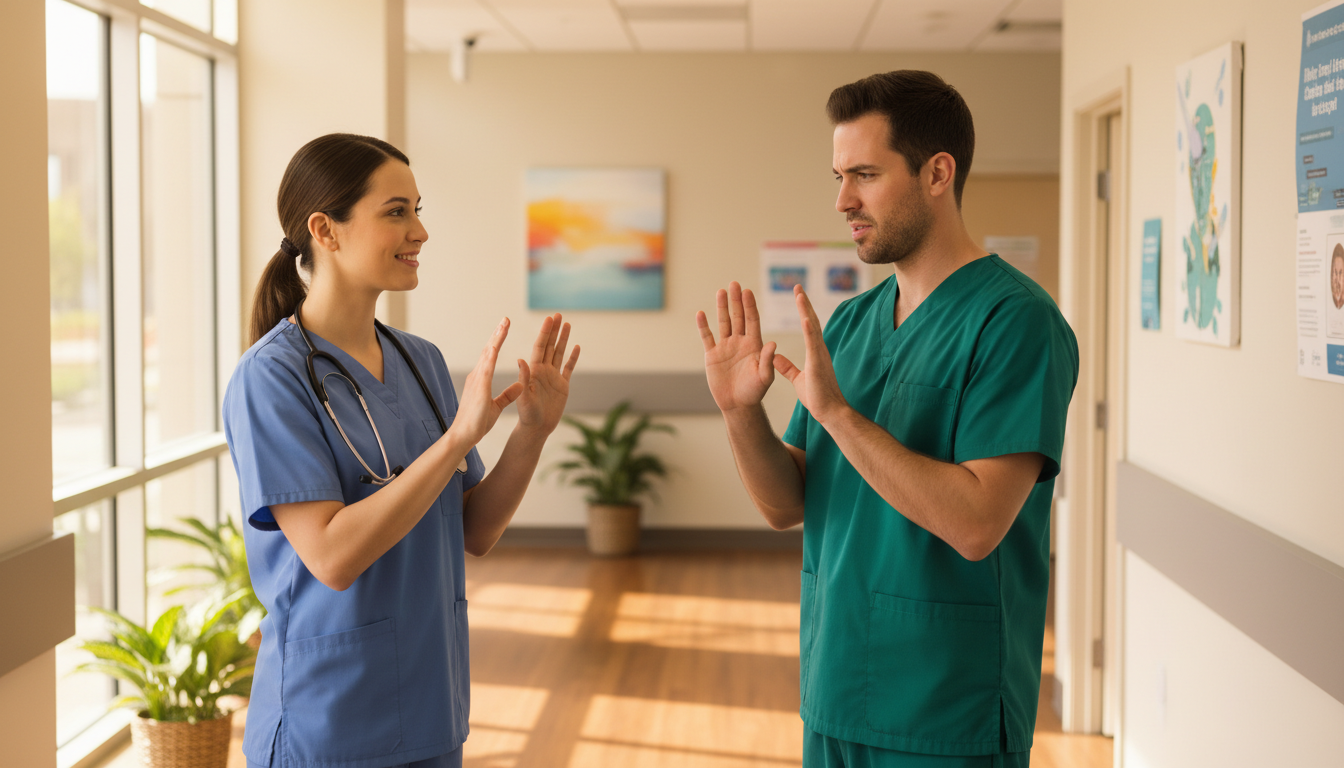
Effective communication requires a tiered approach, as a receptionist’s needs differ vastly from those of a surgeon. Our workplace and professional training focuses on role-specific interactions to maximize utility. For administrative and front desk staff, the focus is on the intake process. Learning signs for "insurance card," "identification," and "please wait" establishes a professional tone from the moment a patient enters the building.
Nursing staff, who provide the majority of direct patient care, benefit from a clinical vocabulary centered on comfort and assessment. This includes the ability to sign the universal pain scale, ask if a patient needs to use the restroom, or explain that a medication is for blood pressure. Physicians and specialists utilize signs to verify consent and ensure the patient understands the roadmap of care. Signs for "procedure," "result," and "questions?" allow the doctor to gauge a patient’s emotional and cognitive state during high-stakes consultations.
Generic courses often fail because they lack this departmental specificity. An Emergency Department team requires high-urgency vocabulary like "accident" or "bleeding," whereas a Pediatric clinic needs signs for "crying," "family," and "vaccine." By tailoring ASL training for healthcare workers to the specific workflow of a unit, facilities ensure that the vocabulary taught is the vocabulary actually used, fostering a higher level of Deaf awareness training and practical efficacy.
The Benefits of Live Online ASL Training for Busy Teams

Static video modules often fail in a clinical context because they lack the corrective feedback necessary for medical precision. A practitioner might inadvertently sign a word incorrectly without realizing it, which could lead to confusion during a high-stakes patient assessment. Through our live, interactive workplace and professional training, teams receive immediate verification that their hand shapes and movements are accurate. This real-time interaction allows clinicians to move beyond generic curriculum and address the specific logistical challenges of their own facilities.
Teams can ask targeted questions about their unique patient populations, such as specific signs for a pediatric wing or navigating the physical layout of their emergency department. This level of Deaf awareness training ensures the instruction is directly applicable to the daily workflow rather than remaining theoretical. By delivering customized ASL training for healthcare workers from our Grayslake studio, Easy Signing LLC provides teams across the country with expert-led sessions that adapt to their specific departmental needs. To begin building a more inclusive environment for your patients, you can contact Easy Signing LLC to discuss a personalized training schedule.
Integrating basic ASL into your medical practice does more than bridge a communication gap; it builds essential trust and improves patient safety. While an interpreter is vital for complex discussions, your ability to provide immediate, accessible care makes a lasting impact. If you want expert help preparing your team for these interactions, our Workplace & Professional Training programs offer tailored solutions for healthcare environments. Together, we can create a more inclusive and supportive clinical experience for every patient.


