
The benefits of learning American Sign Language include significant cognitive improvements such as enhanced spatial awareness and memory; furthermore, it facilitates deeper social connections with the Deaf community and opens diverse career pathways. Mastering this visual language also strengthens overall communication skills and fosters a greater appreciation for cultural diversity.
Many professionals and lifelong learners feel stagnant in their communication skills, often struggling to find a second language that offers both personal fulfillment and immediate, practical utility. While traditional spoken languages are valuable, they frequently lack the dynamic, visual engagement that truly challenges the mind. Learning American Sign Language, or ASL, provides a unique solution by bridging the gap between hearing and Deaf communities while simultaneously sharpening your cognitive functions. In this guide, we will explore why ASL has become the third most studied language in the United States. You will discover how this visual language enhances brain health, creates new career opportunities within the Illinois job market, and fosters deep cultural competence. From improving communication in noisy environments to joining our local Grayslake community, the benefits of signing extend far beyond the fingers.
Why ASL is the Third Most Studied Language in the US
Recent data from the Modern Language Association survey reveals that American Sign Language is now the third most studied language in U.S. higher education, surpassed only by Spanish and French. This surge in interest reflects a profound shift in how we value accessibility and diverse communication styles. While many learners initially seek to connect with the Deaf community, there is a growing understanding that the benefits of learning American Sign Language include unique cognitive and practical advantages to hearing individuals that spoken languages cannot replicate.
In Grayslake and across Lake County, families and professionals are increasingly choosing personal and family ASL classes to build more inclusive environments. This journey often begins with a desire for basic communication, but it evolves into a deeper appreciation for the culture facilitated through Deaf Awareness training. By incorporating customized workplace training, local businesses also recognize that ASL is a vital asset for community engagement. Learning this language is not just a secondary skill; it is a fundamental tool for fostering empathy and removing social barriers.
The Cognitive Workout: How Sign Language Benefits the Brain

Moving beyond social connection, the structural nature of ASL provides a specialized cognitive workout. People often ask, "Is learning sign language good for your brain?" The answer lies in the unique demands of visual-spatial processing. While spoken languages rely heavily on the left hemisphere for grammar and vocabulary, ASL requires the brain to integrate both hemispheres simultaneously. The left side handles the linguistic structure, while the right side manages spatial relationships, hand shapes, and the nuances of facial expressions.
This dual-hemisphere engagement enhances mental flexibility and spatial awareness in ways that auditory languages cannot. Research from the American Psychological Association (APA) suggests that signers often demonstrate superior memory for unnameable objects and complex visual patterns. Because ASL is a three-dimensional language, learners become more attuned to their physical surroundings and develop sharper peripheral vision. Furthermore, National Institutes of Health (NIH) data indicates that learning a signed language can improve co-gesture in speech, meaning the brain becomes more efficient at coordinating physical movement with linguistic thought.
These neural connections contribute to what neurologists call cognitive reserve. By building robust pathways that link visual, motor, and linguistic centers, the benefits of learning American Sign Language include a potential delay in the onset of symptoms associated with aging or Alzheimer’s disease. This is a significant advantage for adults in the Grayslake community looking to maintain cognitive health through lifelong learning.
Participating in personal and family ASL classes provides more than just a communication tool; it fundamentally reshapes how the brain organizes information. As students progress, they often find that their ability to multitask and process complex visual data improves, creating a sharper and more resilient mind. This foundation of mental agility is the first step toward achieving the broader Deaf Awareness training goals that bridge the gap between our hearing and Deaf neighbors.
Practical Communication Advantages in the Hearing World
Beyond the neural benefits, the practical benefits of learning American Sign Language function as a communication superpower in daily life. ASL provides a reliable alternative when the physical environment makes spoken English impossible or ineffective. For residents attending a crowded Grayslake summer festival or a loud community event, signing allows for seamless conversation over the noise. It eliminates the strain of shouting and the inevitable misunderstandings that come with trying to hear over a band, heavy machinery, or a large crowd.
This visual language also overcomes physical and social barriers that stop sound in its tracks. ASL allows for clear, nuanced communication through closed windows, across large distances at a park, or even underwater while swimming. In settings where silence is required, such as a library, a quiet office, or a house of worship, signing offers a way to share information without causing a disturbance. Local businesses are increasingly recognizing this utility; they often seek customized workplace training to ensure staff can communicate effectively in high-noise environments where verbal clarity is compromised.
Perhaps the most relatable application for hearing individuals is within early childhood development. Hearing parents often use ASL with pre-verbal infants to bridge the communication gap that typically leads to toddler tantrums. By participating in personal and family ASL classes, parents can teach their children to sign for specific needs like "hungry," "sleepy," or "more" months before the child can form spoken words. This practical tool reduces household frustration and strengthens the bond between parent and child, proving that ASL is a versatile asset for every stage of life in the hearing world.
Professional Growth and Career Opportunities in Illinois

In the Illinois job market, ASL skills are no longer just a niche advantage; they are a high-demand professional asset. Projections indicate a 46 percent growth in the need for ASL-proficient professionals, a rate that far outpaces many other bilingual specializations. This demand is particularly acute in essential sectors such as healthcare, emergency services, and education. For local Grayslake businesses and clinics, having staff members who possess functional proficiency can be a critical differentiator in service delivery.
Employers increasingly value the ability to offer immediate, basic communication to a Deaf client or patient during the vital minutes before a certified interpreter arrives. In a medical crisis or an emergency situation, the ability to sign "help is coming" or "where is the pain?" provides essential reassurance and safety. Organizations that invest in customized workplace training ensure their teams are prepared for these real-world interactions.
For professionals in Lake County, listing Deaf Awareness training on a resume signals a commitment to accessibility and inclusive service. These benefits of learning American Sign Language extend to every service-oriented role; from a teacher in a local school district to a first responder; making the individual a more versatile and empathetic member of the Illinois workforce. Even basic proficiency demonstrates a proactive approach to community engagement and social responsibility.
Cultural Competence and Deaf Awareness
While professional proficiency provides a competitive edge, the true depth of the language lies in its cultural roots. ASL is far more than a collection of hand shapes; it is a gateway to a rich history and a unique set of social norms. Comprehensive Deaf Awareness training teaches that the Deaf community is a linguistic minority with its own vibrant heritage, storytelling traditions, and etiquette. For instance, understanding the importance of direct eye contact and the specific ways to get someone's attention are just as critical as knowing the signs themselves.
The benefits of learning American Sign Language include a profound shift in perspective from mere observation to active empathy. By removing the barriers to communication, hearing individuals move from being bystanders to becoming allies in the pursuit of social justice. This process facilitates genuine community participation, ensuring that Deaf neighbors in Grayslake are not isolated in public spaces, religious services, or social gatherings. It is a commitment to inclusion that recognizes access as a fundamental human right rather than an optional accommodation.
At Easy Signing LLC, we emphasize that language and culture are inseparable. Our personal and family ASL classes go beyond vocabulary to explore the lived experiences of the Deaf community. We focus on developing the cultural competence necessary to navigate real-world interactions with respect and authenticity. Our customized workplace training for local businesses prioritizes this cultural bridge, ensuring that communication is not just functional but also respectful. Our goal is to foster a Grayslake community where everyone feels seen, heard, and valued.
ASL vs Spanish: Which Language Should You Learn?
Deciding between Spanish and American Sign Language often comes down to how you process information. Spanish relies on auditory memory and linear sentence structures typical of Romance languages. In contrast, ASL is a visual-spatial language that engages the brain through sight and motion. For many students, the benefits of learning American Sign Language include a shorter initial learning curve because the language leverages natural human gestures. Signs for concepts like "drinking" or "giving" often feel more intuitive than memorizing entirely new sounds for the same actions.
Feature | Spanish (Spoken) | ASL (Signed) |
|---|---|---|
Primary Modality | Auditory and Oral | Visual and Spatial |
Learning Style | Linear, phonetics-based | Multi-dimensional, gesture-based |
Scope | Global communication | Local community inclusion |
Intuition | Requires new sound-concept links | Leverages natural physical gestures |
While Spanish boasts millions of global speakers, ASL offers a unique proximity to a community within our own neighborhoods that is often overlooked. Choosing personal and family ASL classes allows you to bridge the gap with the hundreds of thousands of Americans who rely on signing daily. Unlike a foreign language that might primarily be used during international travel, ASL is immediately applicable in local Grayslake businesses and schools. While Spanish expands your global reach, ASL deepens your local impact through specialized Deaf Awareness training and customized workplace training that fosters immediate, real-world accessibility.
Joining the Grayslake ASL Community
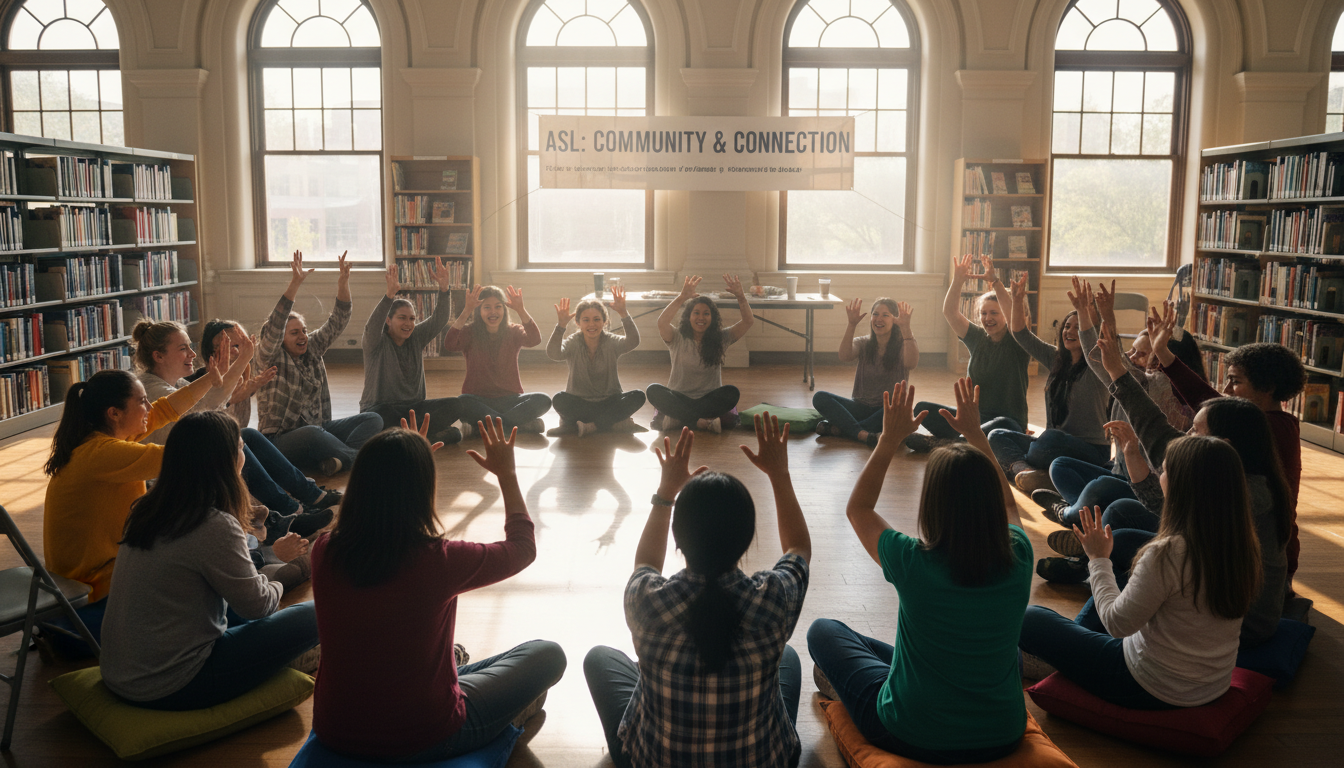
Meaningful integration into the local Deaf community requires moving beyond solitary apps that focus on static vocabulary. The most significant benefits of learning American Sign Language emerge through interactive, group-based instruction. Easy Signing LLC serves as a vital link for Lake County residents by providing live online and customized training environments where students practice receptive skills in real time.
Our personal and family ASL classes focus on conversational dynamics that software cannot replicate. By engaging with instructors and peers in Grayslake, you move past basic hand shapes into fluid dialogue. This collaborative approach, paired with specialized Deaf Awareness training, transforms hearing community members into active allies. For local organizations, customized workplace training ensures that staff are not just memorizing signs but are prepared for real-world accessibility.


