Three Real Stories of Connection, Growth, and Early Communication
Few things are harder for a parent than watching a baby cry and not knowing what the child needs. Is the baby hungry? Tired? Hurt? Frustrated? Asking for more? Ready to stop?
The child may know exactly what they want, but their mouth is not yet ready to form the words. That gap can leave both the child and caregiver feeling helpless. Baby signing can open a door.
“My hands have meaning. When I communicate, someone understands me.”
Throughout my years of teaching American Sign Language, I have worked with babies, young children, parents, grandparents, educators, and caregivers. I have seen that discovery change a child’s expression and a family’s confidence.
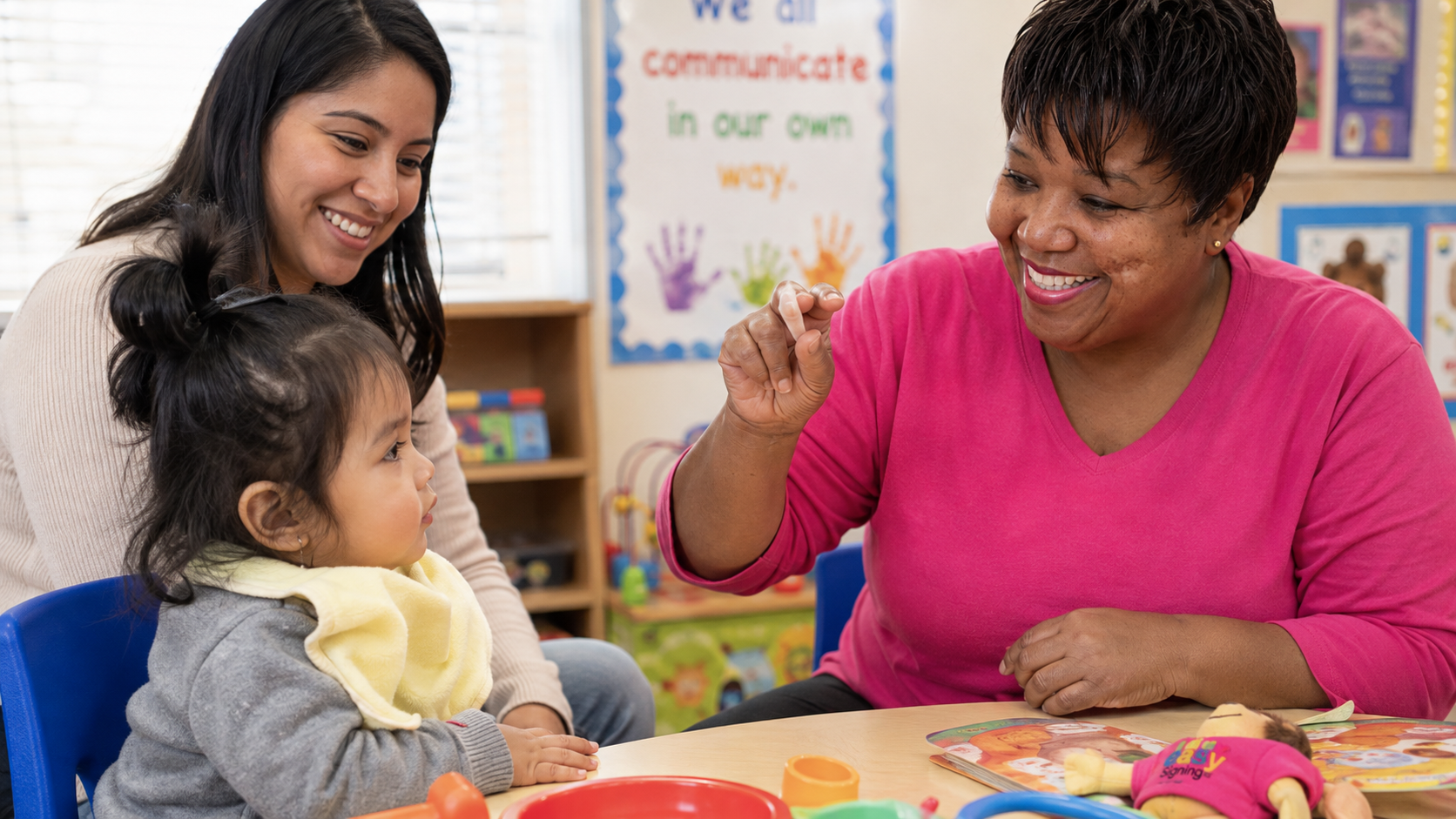
At Easy Signing LLC, I teach useful signs based on American Sign Language. Signing does not replace talking, singing, reading, smiling, or responding to a child. It becomes one more way to build understanding before spoken words are fully developed.
The Real Value of Early Communication
Many people think baby sign language is simply a cute way for a baby to request “milk” or “more.” Those moments are wonderful, but signing can offer much more. A young child can use signs to ask for help, make a choice, say an activity is finished, name a person, or express a feeling. Babies already communicate through eye gaze, facial expressions, reaching, pointing, sounds, and body movements. Signing builds upon that natural desire to connect.
The goal is not a perfect sign. A baby’s first sign may be an approximation, just as a first spoken word may not sound exactly like the adult word. The caregiver recognizes the attempt, responds warmly, and reinforces the meaning. That moment teaches a powerful lesson: communication works.
Story One: When a Child Has Something to Say but Cannot Yet Say It
Families often explore signing because a child understands far more than they can express verbally. The child may point urgently, pull an adult toward an object, cry, or become overwhelmed when no one understands. What looks like misbehavior may actually mean, “I am trying to tell you something, but I do not have a clear way to say it.”
For a child with a speech or developmental delay, signs can provide another way to express needs while spoken communication continues to develop. The child may not yet be able to pronounce “help,” but may be able to produce or approximate the sign. I often encourage families to begin with a small group of practical signs.
When a child realizes that a sign brings a predictable response, confidence can grow. The parents also gain confidence because they have another way to recognize and respond to their child. Signing is not a replacement for a medical, hearing, speech, or developmental evaluation. Families with concerns should continue working with qualified professionals. Signing can become one helpful part of the child’s larger communication plan.
Story Two: When a Deaf or Hard-of-Hearing Child Needs Complete Language Access
When parents learn that their baby is Deaf or hard of hearing, their world may seem to change overnight. They may suddenly face hearing tests, appointments, early intervention, technology choices, and many different opinions.
In the middle of those decisions, one truth must remain clear: every child needs access to language. For a hearing baby, parents may use several ASL-based signs as early communication support. For a Deaf child, however, American Sign Language is not simply a collection of baby signs. ASL is a complete visual language with its own grammar, structure, history, and culture.
A Deaf child needs rich, accessible communication that makes it possible to learn, ask questions, express feelings, understand family conversations, and build relationships. Parents do not have to become fluent overnight. They can begin while feeding, bathing, dressing, playing, reading, and comforting. Siblings, grandparents, and regular caregivers can learn too.
Consistency matters more than perfection. A small number of signs used meaningfully every day is more useful than hundreds studied once and forgotten. Eye contact and facial expression also matter because the face and body help carry meaning in ASL. When the household learns together, the family is saying, “You belong here. We want to understand you, and we want you to understand us.”
Story Three: Signing as a Bridge Between Spanish and English
One of the most meaningful examples from my own work involved Spanish-speaking teen mothers and their babies. The mothers spoke Spanish, while their babies were also beginning to encounter English through childcare and the larger community. Signing became a visual bridge between the two spoken languages.
The mothers did not have to stop speaking Spanish. The babies did not have to wait until they could clearly pronounce words in Spanish or English. An ASL-based sign could carry meaning while spoken vocabulary continued to develop. Signing did not replace the family’s home language or prevent the children from learning English. It added another path to understanding.
For those young mothers, signing also provided confidence. They had a practical tool they could use immediately. They could watch for a sign, respond, and experience the joy of a real exchange before speech was clear. The same idea can help in childcare settings where children are at different developmental stages or speak different home languages. A caregiver can say and sign WASH HANDS, EAT, HELP, or ALL DONE. The spoken word and visual sign work together.
The Research That Strengthened My Work
My belief in early visual communication is grounded in both professional experience and research.
Years ago, I presented the longitudinal Baby Signs research of child-development specialists Dr. Linda Acredolo and Dr. Susan Goodwyn at a MENSA conference in St. Paul, Minnesota. That presentation remains an important part of my professional journey.
Their study followed 103 infants beginning at 11 months of age and assessed them at several points through age three. The researchers reported that encouraging symbolic gestures did not hamper spoken-language development. The signing group also showed an advantage on many language measures compared with the non-intervention group.
A later follow-up included 43 children after they completed second grade. The researchers reported an average WISC-III score of 114 for the signing group and 102 for the comparison group—a 12-point difference. That finding should be shared carefully. The follow-up involved a smaller group and was reported in a conference paper. It should not be used to promise that signing will raise every child’s IQ.
What the research did help demonstrate is that purposeful symbolic gesturing did not delay speech. It supported what many parents and professionals had observed: babies can communicate meaningful ideas through their hands before they can pronounce many words.
My Easy Signing approach is ASL-based. The original Baby Signs study examined symbolic gestures, including gestures created or adapted for infants. ASL is a complete natural language. I believe families benefit when practical early signs are connected respectfully to ASL, visual communication, and Deaf awareness.
Does Baby Signing Delay Speech?
This is one of the first questions parents ask me.
The original study found that symbolic gesturing did not hamper verbal development and might help facilitate it. Families should still be cautious of exaggerated promises that signing will automatically make every child speak earlier or become more intelligent.
The immediate value can be deeply practical. A child gains another way to express a need. A caregiver pays closer attention to movement, facial expression, and eye gaze. Frustration may decrease because the child has an additional communication tool.
When spoken language is accessible, adults should continue to talk, read, sing, and say the word while making the sign. Signing works alongside spoken communication.
How Easy Signing Helps Families Begin
You do not need to memorize an entire dictionary before you begin.
Choose three to five signs connected to your child’s daily life. Say the word and make the sign during the actual activity. Sign MILK while offering milk. Sign MORE before another bite. Sign ALL DONE when the meal ends. Sign HELP before assisting with a toy.
Repeat the signs naturally. Give the child time to watch. Respond to attempts without demanding perfect handshapes. Most importantly, look at the child, smile, and make communication feel like connection rather than a test.
Through Easy Signing LLC, I provide live, interactive Baby Signing training for children from birth to age five and the adults who care for them. Parents, grandparents, siblings, and regular caregivers can learn together, giving the child consistent support.
Training can also be customized for early childhood educators, nannies, childcare providers, multilingual families, families of children with communication delays, and families with Deaf or hard-of-hearing children.
My goal is not simply to help people memorize signs. My goal is to help families create communication that feels useful, respectful, natural, and loving.
Ready to Start Signing With Your Child?
These three stories involve different children and circumstances, but they share one truth: communication changes everything.
Signing can help a child ask for help, connect a Deaf child more fully with family life, or give a multilingual family a visual bridge while spoken words are developing. It can give adults greater confidence and give children the deeply important experience of being understood.
You do not have to be perfect before you begin, and you do not have to learn alone.
Come on, put your hands up, and sign with me!


