
The most effective ASL homeschool curriculum provides a balance of high school foreign language credits, Deaf culture studies, and access to live or expert instruction. Selecting a program that combines video-based vocabulary building with interactive components ensures students develop conversational fluency while meeting state educational standards.
Finding a high quality American Sign Language curriculum for your homeschool can feel like a daunting task, especially when you are balancing state requirements with the desire for authentic learning. Many parents worry that a series of disconnected vocabulary videos will not provide the linguistic depth needed for high school foreign language credits. This decision matters because ASL is a living language that requires more than just mimicry; it demands a deep understanding of syntax and community. In this guide, we will break down exactly how to secure high school credits through ASL. We will also examine the practical differences between self paced videos and live instruction, and explain why integrating Deaf culture is essential for true fluency. By the end, you will have a clear roadmap for structuring a successful school year that values both academic excellence and cultural respect.
Why Add American Sign Language to Your Homeschool Journey

Integrating American Sign Language into a home education plan offers benefits that extend far beyond simply fulfilling a graduation requirement. Research conducted in 2009 and 2010 highlights that hearing children who learn ASL often achieve higher standardized test scores and demonstrate significant receptive language gains compared to their peers. This cognitive boost occurs because ASL requires the brain to process linguistic information spatially and visually, engaging both hemispheres simultaneously. It challenges the mind to think in three dimensions, which reinforces memory retention and mental flexibility.
For many families, selecting a robust ASL homeschool curriculum provides a necessary outlet for kinesthetic learners. Students who struggle with traditional sit and read methods often thrive when language is tied to physical movement and spatial awareness. By using their hands, facial expressions, and body posture to communicate, students ground abstract concepts in tangible action. This physical engagement makes the learning process more dynamic and helps maintain focus for students who need to move to learn effectively.
Beyond the academic metrics, ASL serves as a powerful tool for empathy. It transforms the concept of inclusion from a theory into a practical skill. When children learn to communicate across barriers, they develop a deeper understanding of diverse perspectives and cultural nuances. This makes ASL classes for families an excellent way to bond while building a bridge to the Deaf community. When integrated into community and faith based programs or taught as a standalone elective, ASL encourages students to see language as a means of connection rather than just a subject to be mastered. For those looking for a tailored approach, you can contact us for customized training to meet your family's specific goals.
Does ASL Count as a Foreign Language Credit for High School
One of the most frequent questions parents ask is if ASL fulfills the world language requirement for graduation and college admissions. In the state of Illinois, and in the majority of states across the U.S., American Sign Language is officially recognized as a foreign language for high school credit. This recognition allows students to pursue fluency in a visual language while building a competitive transcript for higher education.
To document these credits effectively, homeschool parents should maintain a comprehensive portfolio for each level of study. A valid transcript entry should include specific details that demonstrate the rigor of the course.
Documentation Component | Details to Include |
|---|---|
Instructional Hours | Log 120 to 180 hours for a full year of credit. |
Course Syllabus | A detailed list of units, including grammar, syntax, and culture. |
Instructor Profile | Credentials or background of the professional leading the course. |
Evaluation Methods | Summaries of assessments, including expressive and receptive skills. |
When students prepare for university applications, parents must verify specific requirements with admissions offices. While most institutions accept ASL, a small number of private or specialized colleges may specifically require a modern spoken language for certain degree paths. If you need assistance developing a curriculum that meets these rigorous standards, you can contact us for customized training to ensure your student’s work is professional and accurately documented for their future academic goals.
Self Paced Videos vs Live ASL Instruction: Which is Right for Your Student

Navigating the sea of options for an ASL homeschool curriculum requires weighing the convenience of pre-recorded videos against the depth of live, interactive instruction. Asynchronous platforms, which rely on large video databases or pre-filmed lessons, offer scheduling flexibility that many families appreciate. However, these tools often fall short because American Sign Language is a three dimensional language. When a student watches a flat screen, they frequently miss the subtle nuances of depth, such as how far a hand is from the chest or the exact angle of a wrist.
Live instruction bridges this gap by providing immediate, corrective feedback. In a live setting, an instructor can instantly spot an incorrect palm orientation or a slight misalignment in hand placement that might otherwise lead to a complete change in a sign's meaning; furthermore, ASL relies heavily on non-manual signals. These signals include facial expressions and body posture, which function as the grammar and "tone of voice" in ASL. Students using self-paced videos often neglect these elements, focusing only on the hands, which results in signing that lacks grammatical clarity and emotional context.
A significant hurdle for self-paced learners is the development of receptive skills. While it is relatively easy to memorize signs and reproduce them, understanding a diverse range of signers in real time is much more difficult. Live interaction forces the brain to process visual information at a natural conversational pace. This two way communication ensures that students are not just learning to output language, but are also learning to comprehend others. Families seeking a more personal touch may find that ASL classes for families or community and faith based programs provide the necessary social context for these skills to flourish. For those with specific scheduling needs or unique goals, you can contact us for customized training to bring live, expert feedback directly to your student.
Beyond Vocabulary: Integrating Deaf Culture into Your Curriculum
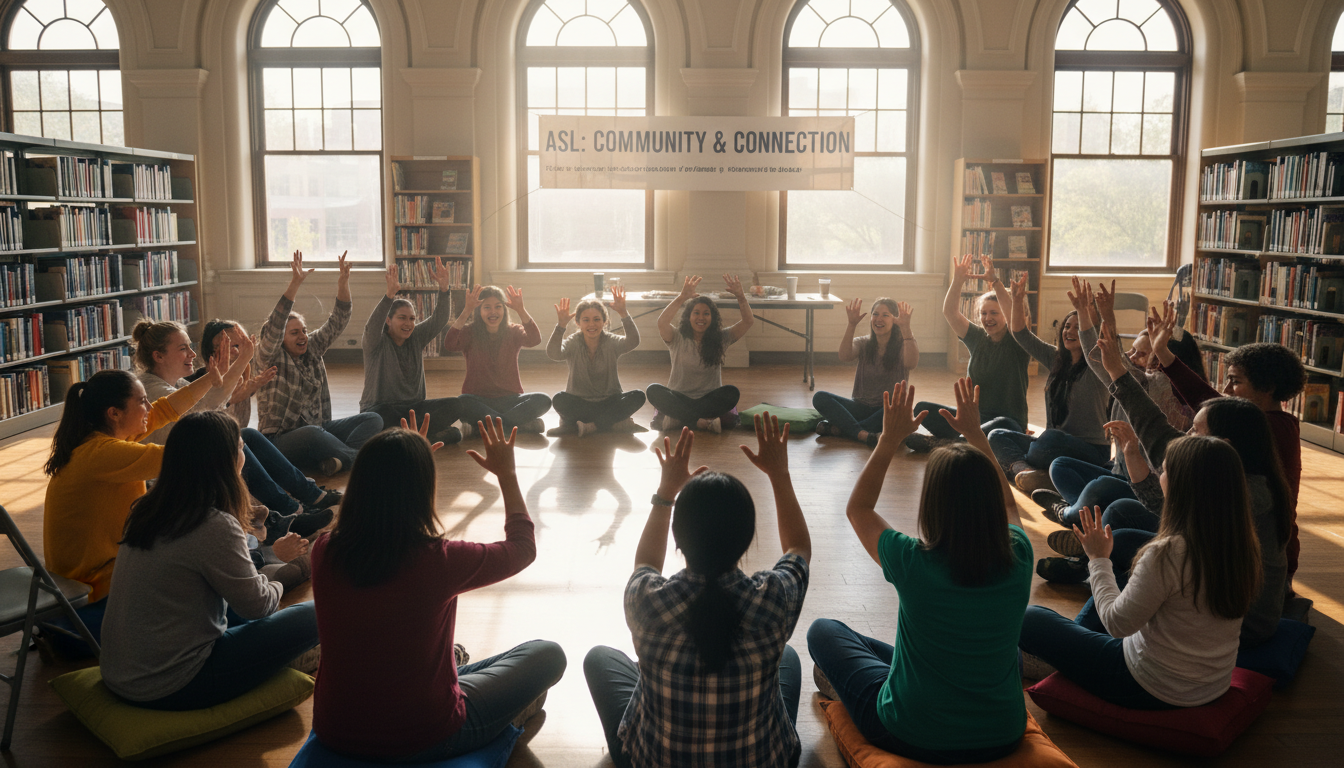
A robust ASL homeschool curriculum must treat American Sign Language as a distinct, living language rather than a collection of translated English words. Without a deep understanding of Deaf culture, students often fall into the trap of coding English, which results in grammatically incorrect signing and significant communication gaps. To avoid this, instruction should focus on the five parameters of ASL: handshape, movement, location, palm orientation, and non-manual signals. Mastering these rules is essential for clarity and ensures the student respects the linguistic integrity of the Deaf community.
Integrating cultural etiquette is equally vital for true fluency. Students need to learn the importance of maintaining consistent eye contact, the proper ways to get someone's attention in a visual environment, and the rich history of the Deaf community in the United States. This foundation in Deaf Awareness helps students navigate social interactions with sensitivity and confidence rather than just mechanical accuracy.
For families in the Grayslake area, practicing these skills in real world settings is highly effective. Look for local Deaf coffee chats or community and faith based programs that offer inclusive environments. If physical meetups are not accessible, engaging with Deaf creators online or participating in ASL classes for families can provide the necessary cultural immersion. For those who want to dive deeper into specific etiquette or history, you can contact us for customized training tailored to your specific curriculum needs.
How to Structure Your ASL School Year
Structuring an ASL homeschool curriculum requires a strategic balance between vocabulary acquisition and spatial practice. To build a robust transcript, parents should organize the study into three distinct levels. ASL 1 focuses on the manual alphabet, basic syntax, and the five parameters of signing. ASL 2 shifts toward spatial agreement and classifiers, while ASL 3 emphasizes fluid storytelling and advanced receptive skills. By treating each level as a full academic year, students have the time necessary to move from mechanical movements to natural expression.
A consistent weekly schedule is vital for developing muscle memory. A four or five day routine might look like this:
Day | Activity Focus | Goal |
|---|---|---|
Monday | Formal Instruction | Introduce new signs and grammar rules. |
Tuesday | Receptive Practice | Review video content or watch Deaf creators. |
Wednesday | Partner Interaction | Practice dialogue with a sibling or parent. |
Thursday | Expressive Review | Record yourself signing to check palm orientation. |
Friday | Cultural Immersion | Explore Deaf history or attend local community events. |
For families in the Grayslake area, you can contact us for customized training to build a syllabus tailored to a specific sibling group or a larger homeschool co-op in Lake County. This personalized approach ensures students meet the required instructional hours while receiving expert, live feedback. Integrating ASL classes for families into your weekly routine provides the interactive environment needed to bridge the gap between individual study and real world communication.
Finding the Best ASL Homeschool Curriculum Resources
Selecting the right materials for an ASL homeschool curriculum involves distinguishing between supplementary tools and core instruction. Free resources, such as Gallaudet University’s ASL Connect, offer excellent visual dictionaries and introductory lessons. These are highly effective for vocabulary building, but they often lack the evaluative components and sequential logic necessary to issue a formal high school grade.
For credit verification on a high school transcript, colleges look for programs led by qualified professionals. A structured course provides the accountability and documentation required to prove a student has met specific linguistic milestones. While self-paced modules offer flexibility, they cannot replace the authority of an instructor who can verify expressive accuracy and receptive fluency. Using a curriculum led by an expert ensures that the hours logged translate into recognized academic achievement.
Resource Category | Best Use | Key Benefit |
|---|---|---|
Free Supplements | Vocabulary building and daily practice | Accessible, visual dictionaries |
Deaf History Resources | Cultural education and research | Depth beyond the language |
Core Instruction | High school credit and fluency | Expert feedback and certification |
Families often find that combining independent study with ASL classes for families or community and faith based programs creates a balanced, professional portfolio. If you are building a specialized high school path and need reliable documentation, you can contact us for customized training to ensure your student’s work meets the standards expected by university admissions boards.


