
To master how to communicate with a Deaf person, you should first get their attention with a wave or tap and then maintain direct eye contact while facing them in a well-lit area. Speak clearly at a natural pace while using body language, facial expressions, or writing to ensure clarity; always address the individual directly rather than looking at an interpreter.
Many people experience a sudden surge of anxiety when they realize they need to communicate with a Deaf colleague or customer for the first time. You might worry about making a social blunder, appearing insensitive, or failing to convey your message clearly. This hesitation, while common, often creates unnecessary barriers to connection and professional inclusivity. Bridging the gap between the hearing and Deaf communities requires intentionality rather than perfection. At Easy Signing LLC, we specialize in providing the practical tools necessary to foster meaningful, respectful interactions. This guide will walk you through the essential etiquette for getting someone’s attention, how to structure a visual friendly environment, and the critical role of consistent eye contact. You will also discover effective strategies for communicating without sign language and learn how to avoid common mistakes that hinder workplace accessibility.
The Nervousness of Your First Conversation
Standing across from a Deaf neighbor in Grayslake or meeting a Deaf colleague for the first time often triggers a specific kind of performance anxiety. Most hearing people feel a deep desire to be respectful; however, the fear of doing something wrong or looking awkward frequently leads to hesitation. It is important to remember that communication is a shared bridge between two people. It does not require a perfect vocabulary to start building that connection.
At Easy Signing LLC, we see this nervousness as the first step toward genuine inclusion. Through our Deaf Awareness training, we help individuals and organizations realize that learning how to communicate with a Deaf person is less about mastering every technical sign and more about establishing clear, visual intent. Successful interaction relies on your willingness to be present and adaptable.
While our Personal and Family ASL classes provide the linguistic tools for deep conversation, the foundation of every interaction is the effort you put into being a visual communicator. You do not need to be a fluent signer to show respect. By focusing on your body language and facial expressions, you signal that you are ready to engage. This mindset shift is the core of our Workplace and Professional training; it moves the focus away from the pressure of perfection and toward the value of human connection.
The First Step: Getting Attention Respectfully
Establishing a connection begins before the first word is signed or written. When learning how to communicate with a Deaf person, the most common question is how to initiate contact without being intrusive. In Deaf culture, getting someone’s attention is a straightforward process rooted in visual and tactile cues that prioritize respect and clear intent.
The most direct method is a gentle tap on the shoulder. It is important to avoid the back, head, or arms; a light, firm touch on the shoulder is the standard for polite interaction. If you are standing further away, a small wave within the person’s peripheral vision is effective. You should avoid large, frantic movements, as these can be startling or perceived as overbearing. Instead, use a natural motion that brings you into their field of vision.
In larger settings, such as a bright office or a local community center in Grayslake, flickering the overhead lights once or twice is an acceptable way to get the attention of a group. It is helpful to differentiate between interrupting and initiating contact. In a hearing context, people often wait for a break in sound. In a visual context, you are initiating a sightline. By using these respectful methods, you demonstrate an foundational understanding of cultural norms, which is a core component of our Deaf Awareness training.
Establishing a Visual Friendly Environment

Once you have gained someone's attention, the physical environment dictates the quality of the interaction. In our Deaf Awareness training, we emphasize the concept of sightlines. This refers to a clear, unobstructed path of vision between both parties. If a person cannot see your face and hands clearly, the connection is effectively broken. You must face the person directly rather than speaking while looking at a computer screen or walking away.
Lighting is a critical factor in a visual friendly environment. A common mistake is standing with your back to a window or a bright light source. This creates a silhouette effect, making your facial expressions and lip movements nearly impossible to discern. Instead, ensure the light is hitting your face directly. If you are in a dimly lit area of a Grayslake restaurant or office, suggest moving to a better lit spot. This simple adjustment shows you understand the mechanics of how to communicate with a Deaf person effectively.
You must also be mindful of physical obstructions. Never cover your mouth with your hands, and avoid eating or chewing gum while speaking. For many in the Deaf and Hard of Hearing community, speech-reading provides vital context. Even if someone uses ASL primarily, your facial expressions remain a grammatical component of the language.
Finally, do not ignore the auditory environment. While a profoundly Deaf person may not hear background noise, many individuals use hearing aids or cochlear implants. These devices amplify all sounds; a loud air conditioner or a crowded room can create a wall of noise that makes focusing on your voice exhausting. Minimizing these distractions is a core part of the inclusive environment we promote in our Workplace and Professional training.
The Golden Rule of Eye Contact
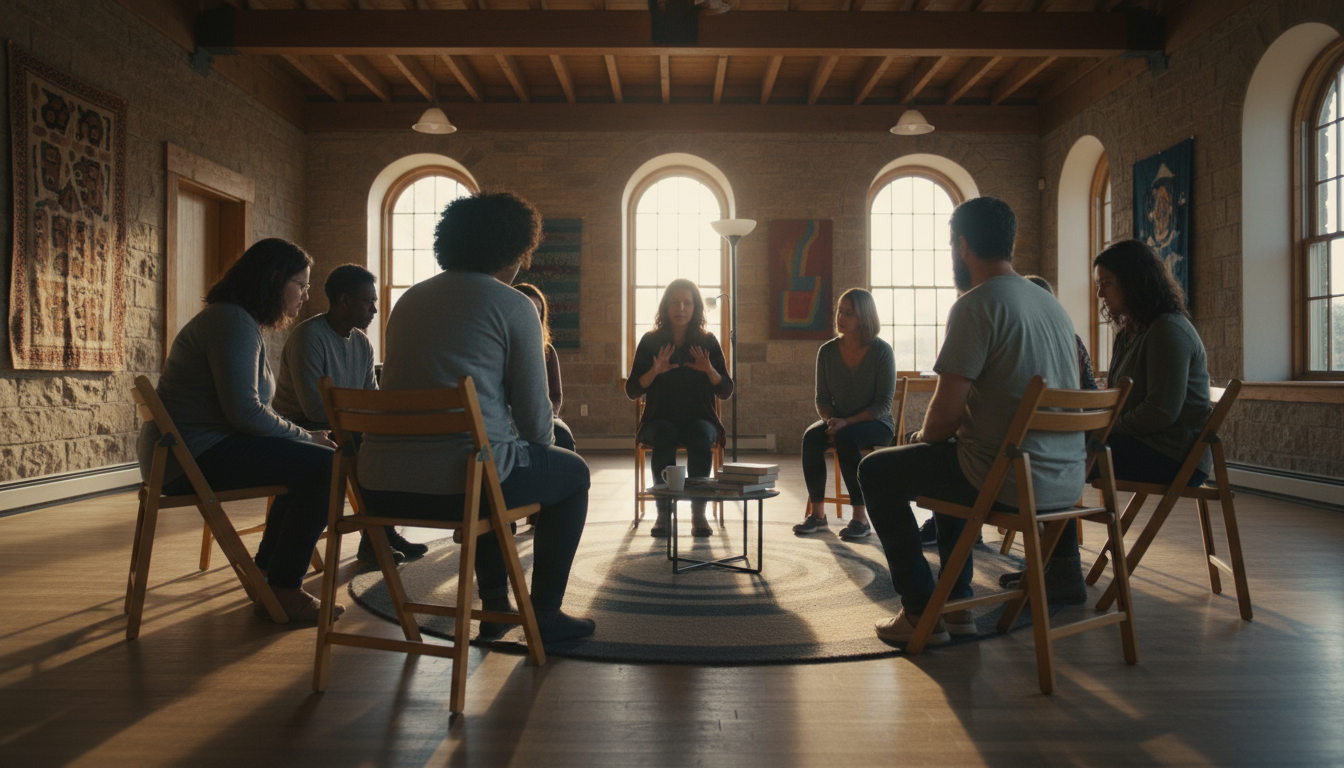
Maintaining a clear sightline is only half of the equation; you must also commit to consistent eye contact. In hearing culture, looking away briefly is often a sign of thinking or a casual pause. In Deaf culture, eye contact is a grammatical necessity. Because American Sign Language is a visual language, the eyes serve as the primary receiver of information. Looking away while someone is signing is the cultural equivalent of hanging up a telephone mid sentence. It terminates the connection and signals that you are no longer listening.
During our Deaf Awareness training, we highlight a specific challenge for those learning how to communicate with a Deaf person through a third party: the interpreter. It is a common reflex to look at the person who is speaking aloud. However, to build a direct human connection, you must look at the Deaf person while you speak and while the interpreter signs back to you. You should use the first person, saying "I" rather than "tell him" or "ask her." By maintaining your gaze on your conversation partner, you acknowledge their presence and humanity rather than treating them as a subject being discussed. This practice ensures the communication remains a direct exchange between two people, which is the cornerstone of inclusive interaction.
Effective Communication Without Sign Language
While eye contact establishes the connection, you must still bridge the linguistic gap when you do not yet share a common vocabulary. Finding a creative middle ground is a practical part of learning how to communicate with a Deaf person effectively. For quick exchanges, your smartphone is an invaluable tool. Opening the 'Notes' app and typing a clear, concise sentence is often the fastest way to share information. In a professional or medical setting, keeping a notepad and pen handy ensures that specific details like addresses, appointment times, or instructions are conveyed accurately without the risk of being misread.
A frequent concern for hearing individuals is whether using gestures is considered rude. Natural, supportive gestures are actually very helpful for providing context. Pointing to an object you are discussing or using universal motions, such as mimicking the act of typing to ask about a report, helps clarify your meaning. However, you must strictly avoid 'mock signing.' This involves making up fake, nonsensical signs or using exaggerated, caricatured movements that parody the language. This behavior is dismissive and disrespectful.
Because ASL is a three dimensional language, your facial expressions serve as the primary way to convey tone and intent. In our Personal and Family ASL classes, we emphasize that the face acts as the adverbs and adjectives of a visual conversation. If you are asking a question, your eyebrows should be raised or furrowed to reflect that inquiry. Using these visual cues, alongside the strategies from our Deaf Awareness training, allows you to be a proactive communicator even before you are fluent. This adaptability is a core component of the Workplace and Professional training we provide to businesses looking to foster true inclusion.
Common Mistakes: What Not to Do
While utilizing creative tools helps bridge the gap, certain well-intentioned habits can actually hinder clarity and damage rapport. One of the most frequent errors hearing people make is shouting. Increasing your volume does not make you easier to understand for someone who is Deaf or Hard of Hearing; instead, it distorts your facial expressions and alters your lip patterns, making them much harder to read. Similarly, you should avoid over-exaggerating your mouth movements. Natural speech patterns are the easiest to follow, while mouthing words excessively creates an unnatural visual rhythm that confuses the message.
The most damaging mistake in any interaction is using exclusionary phrases like "never mind," "it’s not important," or "I’ll tell you later." When a Deaf person asks for clarification and is met with these words, the message received is that the effort to include them is not worth your time. This is a primary focus in our Deaf Awareness training, as these dismissive remarks frequently lead to feelings of isolation. If a message is not understood the first time, do not simply repeat the exact same words. Instead, try rephrasing the sentence. Using different words provides new context clues that may help the individual piece together the meaning. In our Workplace and Professional training, we emphasize that patience and rephrasing are fundamental to maintaining a respectful, productive environment.
Inclusive Communication in the Workplace

Professional environments demand a high level of clarity and structured communication to ensure every team member can contribute effectively. When considering how to communicate with a Deaf person in an office or corporate setting, the focus shifts to systemic inclusion rather than just individual interactions. Inclusive meetings are the cornerstone of this effort. It is essential to ensure only one person speaks at a time; cross-talk is impossible to follow via an interpreter or through speech-reading. Furthermore, providing a brief context signpost before switching topics allows a Deaf colleague to follow the transition without losing the thread of the conversation.
Businesses throughout the Grayslake and Greater Chicago area can significantly improve their internal culture by investing in formal Deaf Awareness training. This training moves beyond basic etiquette and addresses specific professional workflows, such as optimizing video conferencing for visual accessibility. Providing agendas and key talking points in writing before a meeting begins is another high-impact strategy. By implementing these practices, companies transition from mere compliance to a culture of true belonging. Our Workplace and Professional training emphasizes that these accommodations do not just benefit one individual; they improve the communication dynamics for the entire team, fostering a more organized and respectful professional environment.
Building a bridge of communication starts with respect, patience, and a genuine desire to connect. By following these simple tips, you can make every interaction more inclusive and meaningful for everyone involved. While self-guided learning is a wonderful first step, you might reach a point where you want more structured support tailored to your unique needs. If you are looking for expert guidance for your home life, exploring Personal & Family ASL is a natural way to deepen your skills and build lasting confidence.


