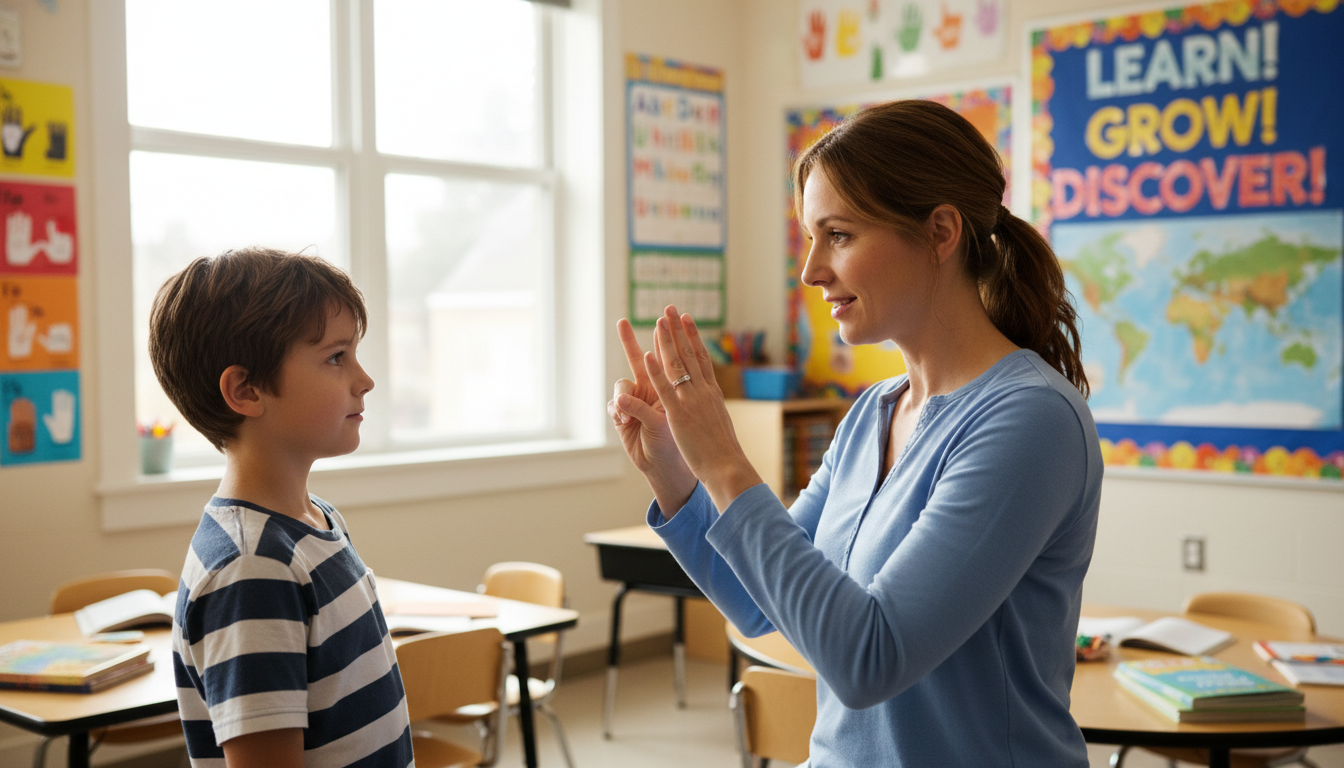
ASL for early childhood educators serves as a vital tool for boosting cognitive development, increasing vocabulary, and supporting pre-literacy skills in inclusive classrooms. Integrating signs into daily routines helps students communicate more effectively and improves their attention spans, spatial memory, and understanding of spoken language. This practice benefits all learners, including dual language learners and children with hearing loss, by providing a multisensory approach to communication and learning.
Managing a classroom of pre-verbal or developing learners often feels like a constant exercise in guesswork; you see the frustration in a child's eyes when they cannot express a basic need, often leading to avoidable outbursts. These communication gaps do more than disrupt your lesson plans; they hinder a child's social and cognitive development during the most critical years of growth. By integrating American Sign Language into your daily routine, you provide a visual bridge that empowers every student to communicate effectively. This guide explores the transformative impact of ASL on early childhood development, addresses common misconceptions regarding speech delays, and offers five practical strategies for immediate implementation. You will also discover why specialized, live training remains the gold standard for staff proficiency and how to cultivate a truly inclusive school culture through Deaf awareness.
The Transformative Impact of ASL in the Early Childhood Classroom
American Sign Language (ASL) is a sophisticated, natural language with its own distinct grammar and syntax. It is much more than a collection of gestures; it is a visual communication system that serves as a complete linguistic foundation. For many years, the conversation in early childhood focused on simple gestures to bridge the gap before speech. However, implementing a structured curriculum centered on ASL for early childhood educators offers far deeper benefits. It provides a multi-sensory bridge that supports pre-literacy and social-emotional growth for every student, regardless of their hearing status.
In the classroom, this shift from basic signing to authentic ASL allows children to process information through visual and kinesthetic channels. Research shows that this visual reinforcement strengthens the connection between concepts and spoken words. For daycare providers and preschool teachers in the Grayslake area, integrating Baby Signing for birth to age five into daily routines is a powerful way to differentiate their programs. By prioritizing customized training for preschools and schools, educators create an environment where inclusion is the standard, not the exception. This approach helps children develop empathy and prepares them for a diverse world while building the cognitive scaffolding necessary for future academic success.
Bridging the Communication Gap: Cognitive and Social Benefits
This visual foundation does more than facilitate silence; it fundamentally alters how young brains process information. Research by specialists like Marilyn Daniels suggests that incorporating sign language into early education improves attention span and visual discrimination. When children track a teacher’s hand movements while hearing the corresponding word, they engage multiple senses simultaneously. This strengthens spatial memory as they learn to navigate the three-dimensional space required for signs, a skill that translates directly into better letter recognition and pre-reading abilities.
Integrating ASL for early childhood educators introduces the concept of the dual language learner to the general education classroom. Hearing children benefit from the visual reinforcement of spoken words; the sign acts as a physical anchor for an abstract sound. This multi-sensory approach is particularly effective for students who may struggle with auditory processing alone. By providing two distinct pathways to the same meaning, customized training for preschools and schools ensures that concepts like "share," "wait," or "help" are deeply encoded rather than just heard.
Perhaps the most immediate benefit observed in daycare settings is the significant reduction in behavioral outbursts. Toddlers frequently experience a developmental gap where their cognitive understanding and desire to communicate far outpace their verbal motor skills. This mismatch is a primary source of frustration that often leads to tantrums. Implementing Baby Signing for birth to age five gives these children a functional tool to express specific needs, such as being thirsty or feeling overwhelmed, before they have the physical ability to articulate those sounds. When a child can successfully signal for help, the need to scream to be understood diminishes, creating a calmer and more productive learning environment for both the students and the staff.
Busting the Myth: Does Sign Language Delay Speech?
The most frequent concern parents voice to educators is whether signing will make a child lazy or delay their spoken words. This common misconception stems from the idea that communication is a zero-sum game. In reality, ASL for early childhood educators serves as a catalyst for speech, not a crutch. Decades of research, including longitudinal studies on Baby Signing for birth to age five, demonstrate that children who sign typically develop larger vocabularies and reach linguistic milestones earlier than their non-signing peers.
Sign language provides a symbolic framework for communication. By assigning a physical handshape to a concept, a child’s brain begins the complex work of labeling the world long before the vocal cords are physically capable of producing clear speech. When verbal ability finally catches up, the child already understands the mechanics of exchange and the power of language. Rather than working against spoken English, ASL works in tandem with it by building the neural pathways necessary for language processing.
When providing customized training for preschools and schools, we encourage teachers to explain to parents that every sign is a win for cognitive development. Signs are the scaffolding upon which spoken words are built, ensuring that a child's ability to express themselves is never hindered by their physical stage of development.
5 Strategies for Integrating ASL into Daily Routines
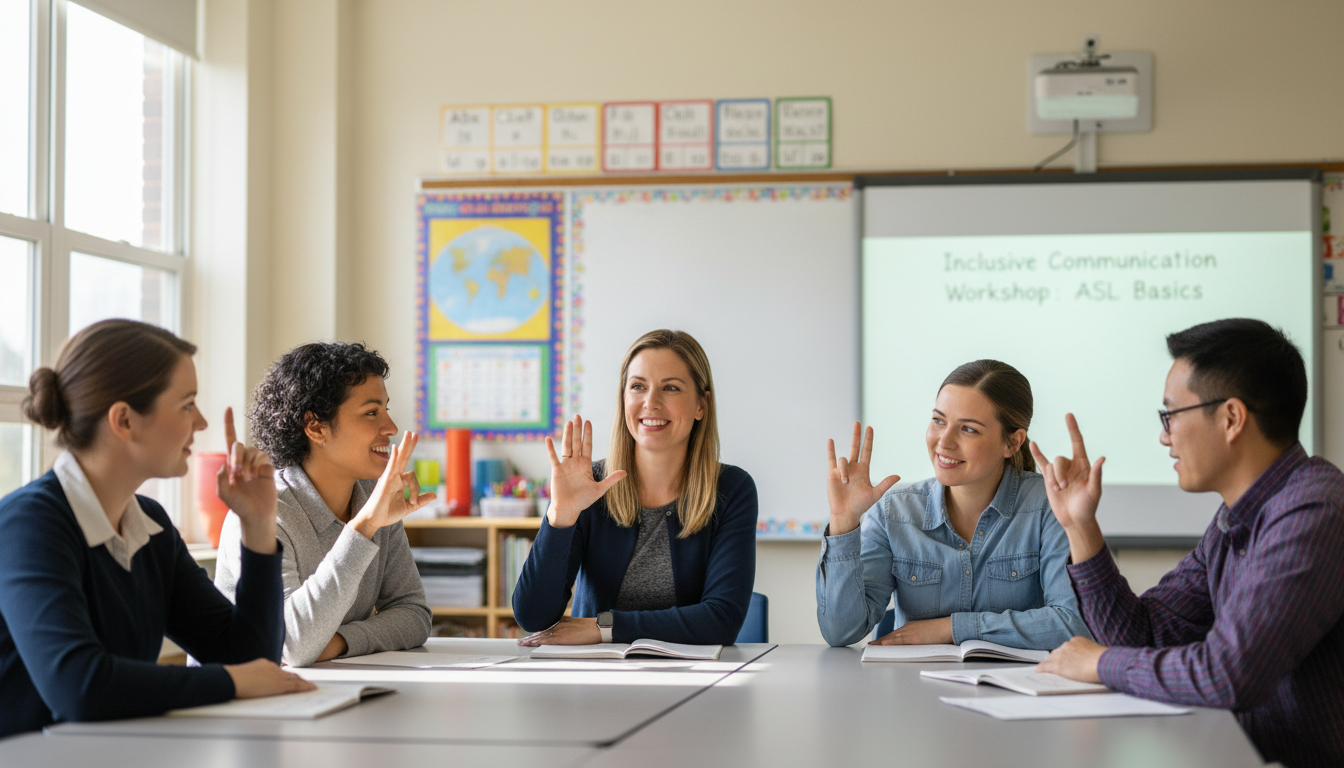
Transitioning from theoretical benefits to practical application requires a deliberate, phased approach. The goal is to embed the language into the classroom culture so that it becomes a natural extension of communication rather than an isolated lesson. For those implementing ASL for early childhood educators, the following five strategies provide a framework for successful integration.
Mealtime Communication: High-motivation moments are the best times to introduce signs. Use signs for "more," "please," and "finished" during snack or lunch. These signs empower children to express their physical needs clearly, which reduces frustration and prevents the shouting that often occurs in communal dining spaces.
Circle Time Songs: Enhance standard preschool songs by replacing generic gestures with authentic ASL. Incorporating signs into songs like "The Itsy Bitsy Spider" or "If You're Happy and You Know It" provides a rhythmic way to practice vocabulary. Using Baby Signing for birth to age five during these group moments helps children associate specific handshapes with linguistic meaning.
Transition Cues: Managing classroom noise is a constant challenge for educators. Using signs for "line up" or "clean up" allows a teacher to give instructions across a busy room without raising their voice. This visual signal acts as a calming cue; children often respond more quickly to a silent sign than to a spoken command that must compete with other sounds.
Emotional Literacy: Teaching signs for "happy," "sad," "angry," and "scared" gives children a physical outlet for their feelings. When a child is in a high-arousal state and cannot access verbal language, they can often still produce a sign to communicate their emotional state, facilitating faster regulation and conflict resolution.
Visual Labeling: Reinforce the environment by adding ASL handshape graphics to classroom labels. A sign for "blocks" or "books" placed alongside the printed word and the physical object creates a triple-coded learning experience. This visual support is essential for pre-readers and helps solidify the connection between the sign and the concept.
To ensure these strategies are sustainable, avoid introducing all five categories at once. A successful model for customized training for preschools and schools involves focusing on one category per month. This gradual pace allows staff members to gain confidence and fluency in a small subset of signs before expanding their repertoire, ensuring that the integration feels like a helpful tool rather than an additional burden on their daily workflow.
Why Live Training Beats Apps and Pre-recorded Video for Staff

Digital apps and pre-recorded videos offer convenience, but they provide a passive learning experience that often leads to undetected errors. ASL is a dynamic, three-dimensional language where subtle changes in palm orientation, handshape, or location can completely alter a word's meaning. Without a live instructor to provide immediate feedback on hand placement, staff members may inadvertently teach incorrect signs, leading to confusion among students.
Live online ASL classes bridge this gap by prioritizing real-time interaction. A critical component of the language is the use of non-manual markers, such as facial expressions and body posture, which provide the grammatical context for signs. An app cannot verify if a teacher’s facial expression accurately matches the intensity of the sign for "scared" or "hurt." Through customized training for preschools and schools, teams receive direct corrections that ensure they are modeling the language accurately for their young learners.
Furthermore, static videos fail to address the unique complexities of a busy classroom. Live sessions allow for role-playing specific scenarios, such as redirecting a frustrated toddler or facilitating a peaceful transition to naptime. This practical application ensures that Baby Signing for birth to age five becomes a functional tool rather than a memorized list of vocabulary. By learning through a Deaf-led perspective, Grayslake educators gain cultural insights that apps cannot replicate, ensuring that the instruction is both linguistically accurate and culturally respectful. This high-touch approach builds the confidence necessary for staff to use ASL for early childhood educators authentically throughout the school day.
Building an Inclusive School Culture Through Deaf Awareness
Integrating ASL into the classroom is about more than vocabulary; it is a vital step toward genuine inclusion. By introducing ASL for early childhood educators, schools provide a gateway to broader discussions regarding human diversity and the rich heritage of Deaf Culture. This perspective shifts the focus from merely accommodating hearing loss to celebrating a vibrant community with its own history and social norms.
Educators can foster this culture by observing Deaf Awareness Month in September through age appropriate activities. Teachers might share stories featuring Deaf protagonists or discuss how visual signals, like flashing doorbells, assist in daily life. Introducing children to the idea that communication happens through many channels, including sight, sound, and touch, builds foundational empathy. For Grayslake area schools, investing in Deaf Awareness training positions the institution as a leader in community inclusion. By normalizing these differences early, you prepare children to navigate a diverse world with respect, ensuring that inclusion is a lived experience within the classroom walls.
Incorporating sign language into your classroom is a powerful way to promote inclusion and support diverse learning styles. By starting with basic signs, you create an environment where every child feels empowered to communicate. If you want expert help to deepen your understanding or train your staff, we are here to support your journey. Our Baby Signing (Birth–5) program offers practical tools for educators looking to master these essential skills. Together, we can build more accessible spaces for all young learners.


