Live online classes are a highly effective way for beginners to gain fluency because they offer interactive curriculums led by expert educators. Choosing to learn ASL online vs in person allows for greater scheduling flexibility and accessibility; meanwhile, in-person options provide immediate feedback within a traditional classroom setting.
You may feel trapped between two extremes. On one hand, you have the rigid schedule of a physical classroom that requires a long commute. On the other hand, you have solitary apps that leave you wondering if your hand placement is actually correct. This uncertainty often prevents beginners from making real progress in American Sign Language. Because ASL is a three dimensional and visual language, the quality of your instruction directly impacts your fluency. In this guide, we evaluate the traditional in-person experience against the modern live online model. We will explore why pre-recorded videos often fail learners, how real-time feedback accelerates your growth, and which format aligns best with your personal goals. By the end, you will understand how to choose a path that offers both convenience and cultural depth.
The Evolution of Sign Language Education: Choosing Your Path
Deciding how to begin your American Sign Language journey often starts with a fundamental question: how do you balance effective learning with a modern schedule? Many students feel torn between the total convenience of a mobile app and the deep immersion of a local college course. This debate over how to learn ASL online vs in person has evolved as technology bridges the gap between these two extremes.
Currently, learners navigate three distinct paths. The first involves self-paced tools like vocabulary apps and pre-recorded videos, which offer high flexibility but limited correction. The second is the traditional in-person classroom, providing physical presence at the cost of rigid scheduling and commuting. The third option, the middle path, is live online instruction. This format combines the interactive feedback of a classroom with the accessibility of digital learning.
Based in Grayslake, Illinois, Easy Signing LLCx̌ specializes in this third path. We provide expert Deaf culture education and customized training for families through a virtual environment that prioritizes real-world communication. Our services range from Workplace and Professional training to community and faith-based programs, ensuring that geography is no longer a barrier to high-quality instruction. Understanding the nuances of each educational format is the first step toward true fluency and inclusion.
The Traditional Route: Benefits and Barriers of In-Person ASL Classes

When evaluating whether to learn ASL online vs in person, it is important to acknowledge why the physical classroom has long been considered the benchmark. The primary advantage of a face to face setting is 3D spatial awareness. Because ASL is a visual and spatial language, seeing a sign from multiple angles allows a student to grasp the depth and precise placement of hand shapes relative to the body. This three dimensional perspective is paired with the absence of digital lag. In a physical room, there is zero latency, which ensures that the rhythmic flow of a conversation remains uninterrupted and natural.
However, the traditional route presents significant barriers that often stall a student's progress before they even begin. Geography is the most persistent hurdle. Not every learner lives near a community college or a Deaf club that offers consistent instruction. Even for those located near our home base in Grayslake, the logistics of a physical course can be prohibitive. Rigid schedules rarely account for the unpredictable nature of modern life, and the hidden costs of commuting, including fuel, parking, and the time spent in traffic, create a high barrier to entry for many.
Despite these constraints, the in person format remains a strong choice for those who need a physical escape to maintain focus. For some, the home environment is filled with distractions that make deep concentration difficult. Stepping into a dedicated classroom provides a psychological boundary that signals it is time to work. It offers a structured sanctuary for those who value a clean break from their daily domestic or professional responsibilities, provided they can manage the commute and the fixed timetable.
The Self-Paced Trap: Why Pre-recorded Videos and Apps Often Fail Beginners
Many beginners start their journey by asking if there is a "Duolingo for ASL." While several mobile apps attempt to gamify the experience, they often lead students into a self-paced trap. These tools excel at teaching static vocabulary, much like a digital dictionary; however, they fundamentally fail to teach American Sign Language as a cohesive, living system. When you weigh the choice to learn ASL online vs in person, it is vital to recognize that a pre-recorded video or a software algorithm cannot see you. It cannot tell if your palm orientation is slightly off or if your hand shape is sloppy.
Without a live instructor to provide immediate correction, beginners frequently bake in technical errors. A minor mistake in hand placement can change the entire meaning of a sign, occasionally turning a polite greeting into an unintended or nonsensical word. These bad habits quickly become muscle memory, making them incredibly difficult to unlearn in more advanced stages. Furthermore, apps rarely address the most critical components of ASL: facial grammar and body shifting. In ASL, a raised eyebrow or a slight tilt of the head functions as punctuation and tone. A static screen cannot evaluate your non-manual markers or teach you how to shift your torso to represent different speakers in a conversation.
Receptive skills also suffer in a self-paced environment. Watching a polished, slow-motion video of a single sign is a far cry from understanding a native signer in a real-world setting. Beginners who rely solely on apps often find themselves paralyzed when a Deaf person signs back to them at a natural pace. True inclusion requires the ability to process spatial information in real time, a skill that requires interactive, human-led instruction rather than a repetitive algorithm. Relying on apps alone ignores the cultural nuances and linguistic depth that define the Deaf community, leaving the learner with a list of words but no way to truly communicate.
The Live Online Advantage: Why Live Virtual Classes are Different

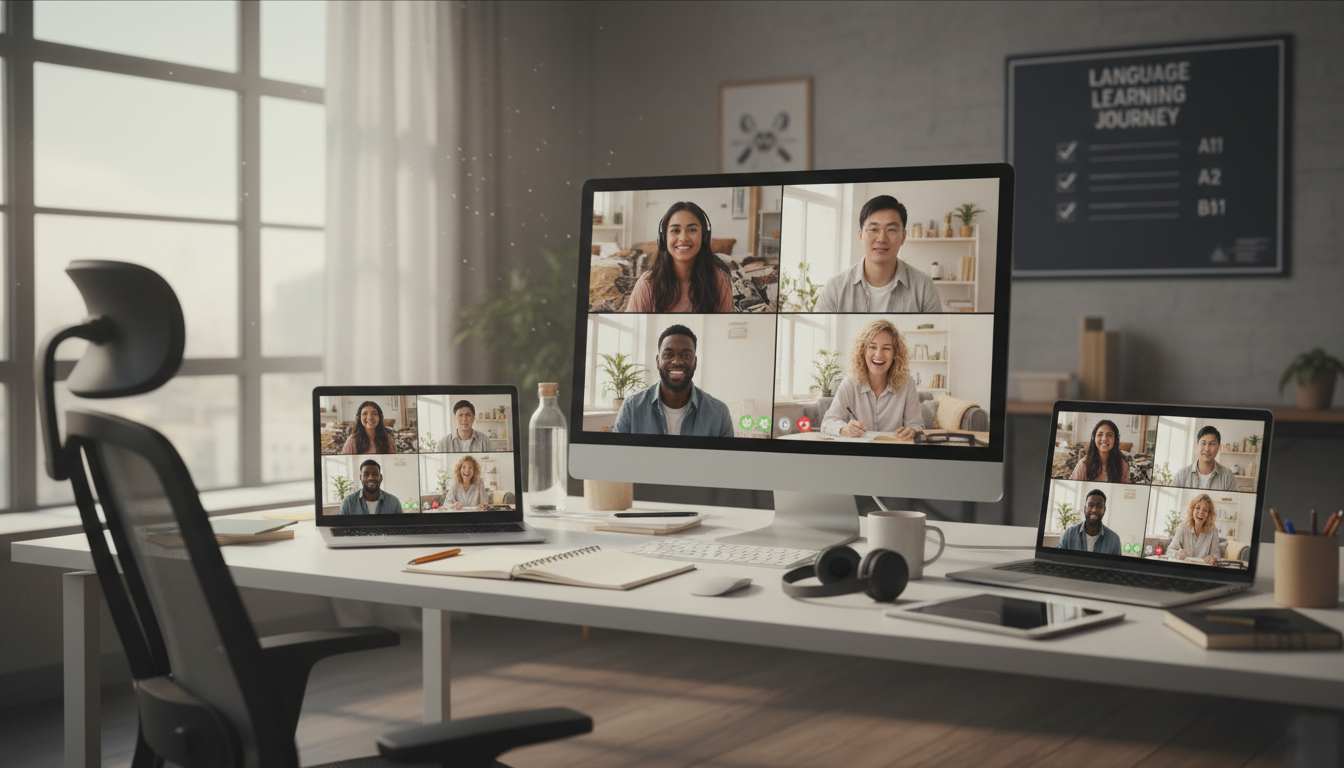
The confusion surrounding how to learn ASL online vs in person often stems from a misunderstanding of what online learning actually entails. Many prospective students conflate live virtual instruction with passive, pre-recorded content. At Easy Signing LLC, our live online classes utilize synchronous learning, which means you are engaging with a Deaf instructor in real time. This is not a one way broadcast like a YouTube tutorial; it is a dynamic, two way exchange where the instructor provides immediate corrections to your handshape, palm orientation, and movement. This feedback loop is essential for beginners to avoid the technical errors that often go unnoticed in self-paced study.
Modern virtual platforms offer specific tools that replicate and, in some cases, enhance the traditional classroom experience. We utilize breakout rooms to facilitate peer-to-peer practice, allowing students to engage in natural conversation in a low pressure environment. High definition video conferencing also solves a common issue found in large physical lecture halls: visibility. In a live virtual setting, every student has a front row seat. The camera framing ensures that facial grammar and non-manual markers, such as eyebrow positions and mouth morphemes, are clearly visible and easy to mimic.
This format provides a critical bridge for local families in Grayslake who need specialized support but cannot commit to a rigid commute. It also allows us to deliver high quality Workplace and Professional training to organizations across the country that lack access to local Deaf educators. By prioritizing live interaction over static content, businesses and community groups can foster genuine inclusion without the logistical hurdles of a physical meeting space. The result is a learning environment that is as linguistically rigorous as a physical classroom while remaining flexible enough for the modern professional schedule.
Comparing Effectiveness: Real-time Feedback and Deaf Culture Immersion
Measuring the effectiveness of culture and feedback reveals distinct strengths for each format. In a physical classroom, students experience a direct social immersion that is hard to replicate, often involving tactile cues and shared physical energy. However, live online sessions offer a unique pedagogical advantage through integrated multimedia. An instructor can seamlessly transition from signing to sharing historical archives, video clips of regional dialects, or digital diagrams of Deaf history. This creates a rich, layered Deaf-space where linguistic instruction and cultural context are inextricably linked, particularly in our community and faith-based programs.
A common concern voiced in digital forums involves the ability to read body language. Critics often worry that the camera limits the viewer's field of vision. In reality, modern high-definition video and proper camera framing ensure that the student sees the entire signing box, which is the area from the waist to just above the head where the majority of communication occurs. Because the instructor is positioned directly in front of their camera, students often get a clearer, more intimate view of subtle facial grammar and non-manual markers than they would sitting in the middle or back of a large physical room.
When you evaluate the choice to learn ASL online vs in person, consider how feedback is delivered. Both formats allow for a voice-off environment, forcing students to rely entirely on their visual skills. While in-person learning provides physical proximity, live online learning allows for a level of visual focus that can accelerate receptive skills. This environment encourages students to attend to the signer's face and upper body with a level of intensity that builds the high-speed processing necessary for real-world interactions.
How to Decide Between Online vs In-Person for Your Learning Style

Deciding how to learn ASL online vs in person requires an honest assessment of your lifestyle and learning goals. While both formats provide the necessary voice-off environment, your choice should align with your specific needs for speed, social interaction, and accessibility.
Your Primary Goal | Recommended Format | Why It Works |
|---|---|---|
Supporting a Deaf family member | Live Online | Provides immediate, customized training for families without waiting for a semester to start. |
Professional development | Live Online | Enables Workplace and Professional training for teams across multiple locations simultaneously. |
Cultural and social connection | In-Person | Offers a dedicated escape from home and direct physical engagement with a local community. |
Specialized scheduling | Live Online | Eliminates commute times for parents and busy professionals while maintaining real-time feedback. |
If you have a Deaf family member and require immediate help, live online instruction is often the superior choice due to its ability to target specific vocabulary and household scenarios quickly. If you view your ASL journey as a way to get out of the house and meet new people, in-person classes offer that physical sanctuary. By 2026, the most critical factor for success is the live nature of the instruction, not the physical room. As long as the interaction is synchronous and led by a qualified Deaf instructor, you can gain the receptive skills and cultural awareness required for true inclusion.
Choosing the right learning format depends on your schedule and goals. While online classes provide convenience, live instruction offers the immediate feedback necessary for mastering nuances like hand placement and facial expressions. This balance helps beginners build strong foundations quickly. If you want expert help to guide your progress, you might find our Personal & Family ASL programs to be a helpful resource. We are happy to provide the personalized support you need to communicate clearly and confidently with those who matter most.


