
Effective ASL fingerspelling practice requires a combination of interactive tools to build speed and strategic focus on word shapes and patterns. Learners can improve their receptive skills by utilizing dedicated apps and video series that challenge their ability to understand fast signing through context and visual flow.
Many ASL students feel a wave of panic when a conversation moves from signs to fingerspelling. Whether you struggle to decode a rapid fire name or feel like your own hand is stuck in slow motion, this disconnect creates a significant barrier to natural interaction. Mastering these manual letters is about more than memorizing the alphabet; it is the essential bridge that connects basic vocabulary to true conversational fluency. Without clear fingerspelling, you lose the ability to share names, specific locations, and technical terms that define precise communication. In this guide, we provide professional strategies to help you prioritize clarity over speed and shift your receptive focus toward word shapes rather than individual letters. You will also learn exactly when to use fingerspelling and discover specific drills designed to move your skills from hesitant to high performance.
Why Fingerspelling is the Bridge to Fluency in American Sign Language
Fingerspelling, often referred to as the manual alphabet, consists of 26 distinct handshapes that correspond to the English alphabet. While American Sign Language is a complete, standalone language with its own unique grammar and syntax, fingerspelling serves as the vital connective tissue. It bridges the gap between ASL and English for concepts that do not have a dedicated sign. This is essential for communicating proper nouns, such as the names of colleagues in Workplace and Professional Training, specific brands, and specialized technical terms.
Many learners encounter a significant frustration known as the speed wall. This occurs when you can successfully produce individual handshapes but struggle to string them together fluidly or, more commonly, find it impossible to decode what a native signer is spelling back to you. This disconnect often stems from treating fingerspelling as a series of isolated letters rather than a cohesive unit of meaning.
Developing a high level of proficiency requires dedicated ASL fingerspelling practice that balances two distinct skill sets. You must cultivate expressive clarity so others can read your signs easily, and you must build receptive stamina to recognize words at a conversational pace. This guide provides the framework to move beyond the basics and master both sides of the communication loop.
Mastering Expressive Fingerspelling: Clarity Over Speed

Establishing a proper "box" is the first step toward clear communication. This refers to the small area of space near your shoulder, slightly to the side of your chin. Keeping your hand within this window ensures that the person you are signing with can see your hand and your facial expressions simultaneously without their eyes having to dart back and forth. Avoid letting your hand drift toward the center of your face or reaching too far toward the person you are speaking to, as this distorts the perspective of your handshapes.
When beginners in our Personal and Family ASL classes ask if they should bounce their hand for each letter, the answer is a firm no. Bouncing or "punching" each letter creates visual noise, making the word look like a strobe light to the receiver and causing significant eye fatigue. The goal of your ASL fingerspelling practice should always be legibility rather than velocity. To maintain a smooth flow, keep your elbow tucked comfortably at your side and your wrist relaxed. Tension in the forearm leads to jerky movements that obscure the distinction between similar letters like "M," "N," and "T."
Handling double letters requires a subtle shift rather than a large movement. For letters that involve a closed handshape, such as "S" or "O," you can use a small, crisp tap to the side to indicate the second letter. For open letters like "L" or "D," a slight outward slide is the standard technique. These movements should be minimal; a half inch is usually enough to signal the repetition.
Maintaining a steady rhythm is far more impressive than signing at high speeds. In any professional environment or within community-based ASL programs, a consistent pace allows the listener to process the word as a cohesive unit. If you rush through the easy letters only to stumble on a difficult transition, you break the receiver's concentration. Clarity ensures your message is understood the first time, every time.
Developing Receptive Skills: Reading the Shape of the Word

Most ASL students find that their ability to spell words far outpaces their ability to read them. This disparity is a natural part of the learning curve; your brain is training to process rapid visual data in a way it never has before. To move past the plateau of seeing isolated letters, you must shift your focus toward pattern recognition. Instead of trying to decode every individual handshape, aim to see the overall shape or silhouette of the word.
Think of how you read a printed sentence. You do not consciously sound out every character; you recognize the visual profile of the word as a whole. In ASL fingerspelling practice, this means noticing the visual rhythm and the ups and downs of the handshapes. A word like "apple" has a distinct silhouette: the "A" is a compact fist, the "P"s drop down, the "L" reaches up, and the "E" returns to a compact shape. Recognizing these contours allows you to process information much faster than mental translation ever could.
To improve your receptive speed, prioritize the anchors of the word. Focus intently on the first and last letters while letting the middle letters blur into a general movement. Combining this with context clues is the most effective strategy for comprehension. If you are participating in community-based ASL programs and the topic is local geography, your brain should already be primed for words like Grayslake or Lake County. If you catch a "G" at the start and a "K" or "E" at the end, the context fills in the gaps for you.
Do not become discouraged if you miss a letter or two. Requesting a clarification is a standard part of communication, even for experienced signers. By focusing on the flow rather than the fragments, you build the visual stamina needed for fluid, real world conversation.
When to Fingerspell: Names, Places, and Loan Signs
Transitioning from recognizing handshapes to using them in conversation requires understanding the linguistic boundaries of American Sign Language. Fingerspelling is not a substitute for signing; rather, it is a specialized tool used for specific categories of information. The primary use case is for proper nouns. This includes the names of people, specific brand names, and titles of creative works like books or movies. If you are discussing a specific location, such as Grayslake or Lake County, you will spell the name out unless a locally recognized sign is established.
Another essential category involves lexicalized fingerspelling, often called loan signs. These are words that were originally fingerspelled but have evolved into distinct signs with their own unique movement patterns and palm orientations. Common examples include #DOG, #JOB, #BACK, and #ALL. These signs do not follow the standard letter by letter rules; instead, they are executed as a single, fluid unit of meaning. Integrating these into your ASL fingerspelling practice is vital for achieving a natural, conversational flow that mirrors how native signers communicate.
A common mistake for students in Personal and Family ASL classes is attempting to fingerspell every English word in a sentence. Because ASL is a conceptual language, you should always use a sign if one exists. For instance, in Workplace and Professional Training, you would sign the concept of "manager" rather than spelling the word, but you would fingerspell the manager's specific name. In community-based ASL programs, you may notice that people eventually use "name signs" to refer to each other. However, these are gifted by the Deaf community. Until you are given one, you should continue to spell your name clearly to ensure there is no ambiguity in your identity.
Effective ASL Fingerspelling Practice Drills and Tools
Building the muscle memory necessary for fluid communication requires moving beyond sporadic study and into structured, daily ASL fingerspelling practice. To begin, utilize digital tools that simulate real world speeds. Websites like fingerspell.net allow you to customize word length and speed, while ASL Speed Spell provides a gamified way to drill receptive skills. These tools are excellent for high volume repetition, but they should be supplemented with specific, physical drills.
Shadowing: Watch a video of a native signer and attempt to spell exactly what they spell in real time. This technique helps align your rhythm with natural linguistic patterns and improves your transitions between letters.
Local Landmark Drills: Practice spelling names you encounter daily in the Grayslake area. Master the spelling of "Grayslake," "Lake County," and specific local streets or parks. Because these are terms you are likely to use in conversation, they should be the first words your hand learns to form without conscious thought.
Physical Vocabulary: Keep a list of words you struggle to sign clearly. Repeat these ten times each morning, focusing on the transitions between difficult letter combinations like "O" to "R" or "B" to "E."
While solo drills build a foundation, they cannot replace the nuance of live interaction. Using apps helps with speed, but participating in Personal and Family ASL classes or Workplace and Professional Training offers the immediate corrective feedback necessary to fix hand positioning and posture. In a classroom setting, you learn to read diverse "handwriting" styles, which vary significantly from person to person. Solo practice sharpens the tools, but live engagement in community-based ASL programs is where those tools are forged into true conversational skill.
The Value of Real World Interaction for Fingerspelling Mastery
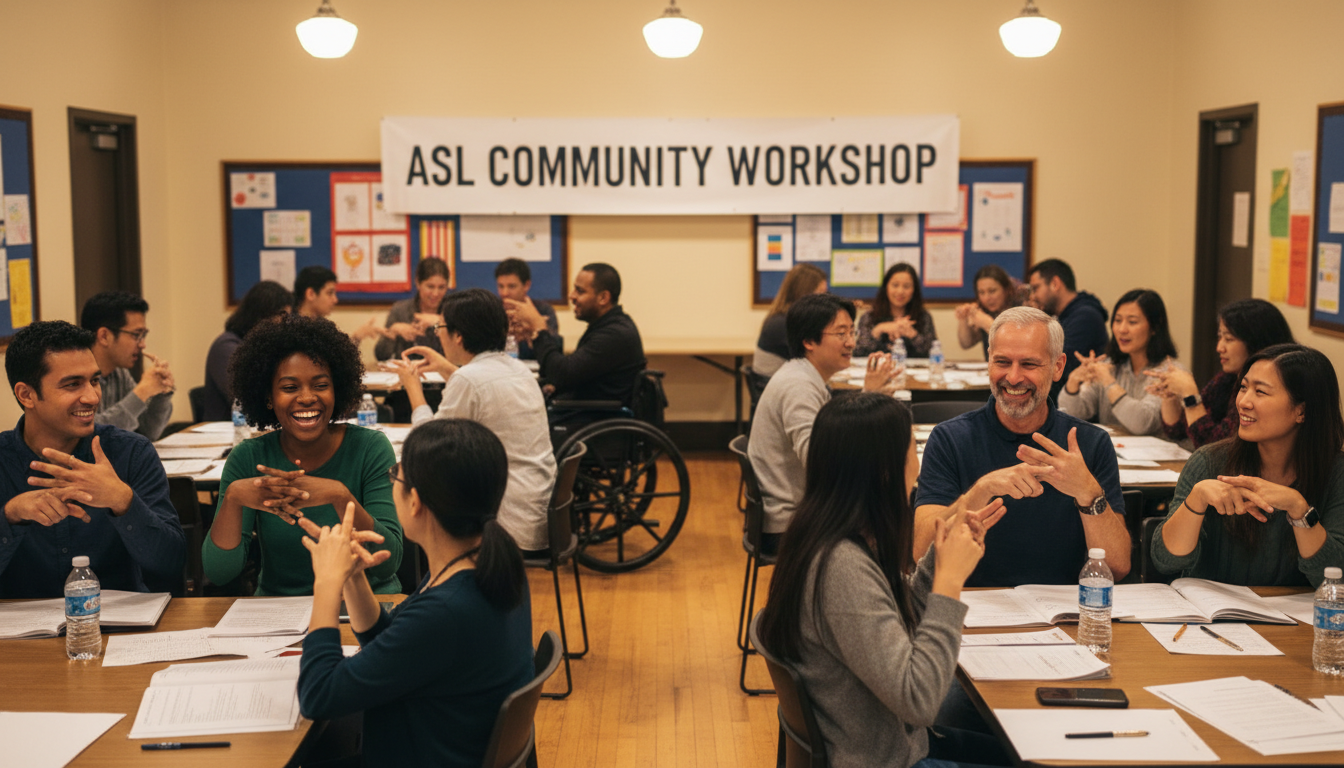
Digital tools offer a controlled environment, but they cannot replicate the organic nuances of human interaction. Every signer possesses a unique visual handwriting, influenced by hand size, finger flexibility, and personal rhythm. Relying solely on software for your ASL fingerspelling practice leaves you unprepared for these variations. In a live setting, you might encounter a signer who holds their hand at a slight angle or someone whose transitions are exceptionally brisk. Engaging with different people trains your brain to remain adaptable and resilient.
Easy Signing LLC’s live online classes bridge this gap by providing immediate, professional feedback. An app can tell you if you identified a letter correctly, but it cannot see if your wrist is straining or if your hand is drifting outside the box. Our instructors identify these subtle mechanical issues before they become ingrained habits. This real-time correction is essential for anyone enrolled in Workplace and Professional Training or Personal and Family ASL classes who needs to communicate with confidence. Ultimately, the purpose of mastering fingerspelling is to foster genuine inclusion. When you can comfortably navigate a conversation in community-based ASL programs, you move past the mechanics of the language and begin building authentic relationships within the Deaf community.
Building strong fingerspelling skills is a fundamental step toward ASL fluency. By focusing on both clear expression and steady receptive practice, you will notice gradual improvement in your daily interactions. If you want expert help to refine your technique or overcome specific hurdles, our team is here to support you. You can find specialized guidance through our Personal & Family ASL programs. These sessions offer a structured way to practice with professionals who understand your goals; providing the personalized feedback necessary for lasting success.


