Learning how to be an ally to the Deaf community involves prioritizing Deaf voices over personal feelings and ensuring that community resources remain within their control. Practical steps include attending Deaf-led events, advocating for workplace accessibility, and practicing respectful communication habits like maintaining eye contact.
Many hearing individuals feel a genuine desire to support the Deaf community, yet they often hesitate because they fear saying the wrong thing or overstepping boundaries. This uncertainty can create a barrier to meaningful connection, leaving well-intentioned people stuck in a cycle of passive awareness rather than active advocacy. True allyship requires a shift from simply acknowledging challenges to intentionally dismantling them through informed, respectful action. By prioritizing Deaf voices and mastering practical communication strategies, you can transform your intent into tangible impact. In this guide, we will explore the core principles of professional interaction, the importance of Deaf-led training, and how to champion accessibility in your local community. You will learn to navigate mistakes with grace and implement a daily checklist that ensures your support is both effective and empowering.
Understanding the Shift from Awareness to Allyship
Awareness is often the first step, but it is fundamentally a passive state. You might recognize that over five percent of the world's population experiences hearing loss, or you may be aware that American Sign Language is a vibrant, visual language. However, simply knowing these facts does not change the environment for those around you. At Easy Signing LLC, we emphasize that learning how to be an ally to the Deaf community requires moving from mere recognition to active advocacy. Allyship is not a self-conferred title or a permanent identity; it is an ongoing practice that must be performed daily through intentional, respectful choices.
A critical component of this journey is understanding the nuanced terminology used within the community. There is a significant distinction between "deaf" and "Deaf." The lowercase "d" generally refers to the medical or audiological condition of hearing loss. In contrast, the uppercase "D" signifies a cultural identity. Members of the Deaf community share a common language, ASL, and a rich heritage. They often do not view themselves as individuals with a medical deficit, but rather as a linguistic minority with a unique cultural perspective.
True allyship involves listening to these voices and taking concrete steps to dismantle systemic barriers. This practice starts with Deaf Awareness Training to understand the history and values of the community. It requires a commitment to the principle of "nothing about us without us," ensuring that Deaf individuals are leading the conversations that affect their lives. This process is a continuous loop of learning and adjusting. It is about building a bridge between the hearing and Deaf worlds through consistent, practical engagement rather than passive observation.
The Core Principles of Respectful Communication

Transitioning from awareness to action requires mastering the specific etiquette of visual communication. One of the most significant shifts for hearing people is understanding the weight of eye contact. In hearing culture, eye contact can be intermittent; however, in the Deaf community, it is the primary indicator of respect and attention. Breaking eye contact while someone is signing is equivalent to plugging your ears or walking away while someone is speaking. It signals that you are no longer listening. Maintaining a steady gaze shows you value the speaker's message and their presence.
Another pillar of respectful engagement is practicing voice off etiquette. When you enter a Deaf space, such as a social gathering or a specialized Deaf Awareness Training session, it is culturally appropriate to stop using your spoken voice entirely. Talking over signs in a mixed environment is often seen as exclusionary because it prioritizes a mode of communication that not everyone can access. Even if your signing skills are limited, making the effort to use visual cues, gestures, or written notes demonstrates how to be an ally to the Deaf community by prioritizing their linguistic comfort over your own convenience.
When a sign language interpreter is present, many hearing people instinctively look at the person speaking the English translation. To maintain professional and personal respect, follow this protocol:
Position yourself so you can see both the Deaf person and the interpreter in your peripheral vision.
Maintain direct eye contact with the Deaf person, not the interpreter, throughout the entire exchange.
Speak directly to the person using first person language. Say "What is your opinion?" instead of telling the interpreter "Ask them what their opinion is."
This approach honors the autonomy of the individual you are speaking with. These habits signal that you recognize ASL as a complete, living language and are committed to a partnership based on mutual respect rather than a medical or charitable perspective. By centering the visual needs of the community, you ensure that communication remains a shared, inclusive experience.
Practical Allyship in the Workplace and Professional Settings

Professional allyship requires moving beyond the bare minimum of legal reasonable adjustments and toward a standard of cultural inclusion. In Illinois, businesses must adhere to accessibility standards set by the ADA and state-specific codes, but true equity happens when a team proactively removes barriers before being asked. When considering how to be an ally to the Deaf community in the office, the focus should be on creating a visually accessible environment where a Deaf colleague can participate as an equal peer, not an afterthought.
One of the most effective ways to support Deaf professionals is to institutionalize visual-first communication. Advocate for high quality captions on all internal training videos and pre-recorded company announcements. During live meetings, ensure that agendas and supporting documents are distributed at least 24 hours in advance. This allows Deaf employees and their interpreters to review technical vocabulary and context, which reduces the cognitive load during the actual session. If you are hosting a webinar or a remote town hall, make it a standard practice to hire qualified interpreters rather than relying on automated captions, which often fail to capture nuance or industry-specific jargon.
Fostering a healthy workplace culture also means understanding the linguistic styles of ASL. Deaf culture often values directness, which hearing colleagues might mistakenly perceive as bluntness or rudeness. In a professional setting, this directness is a sign of clarity and respect for the time of others. Embracing this communication style, rather than asking a Deaf employee to soften their tone to match hearing norms, is a powerful act of allyship. To truly shift the company culture, businesses should invest in Workplace & Professional Training led by Deaf instructors. Bringing in a Deaf-led organization for Deaf Awareness Training ensures that your staff learns directly from those with lived experience, keeping instructional power and resources within the community.
Supporting Deaf Culture in Your Local Community
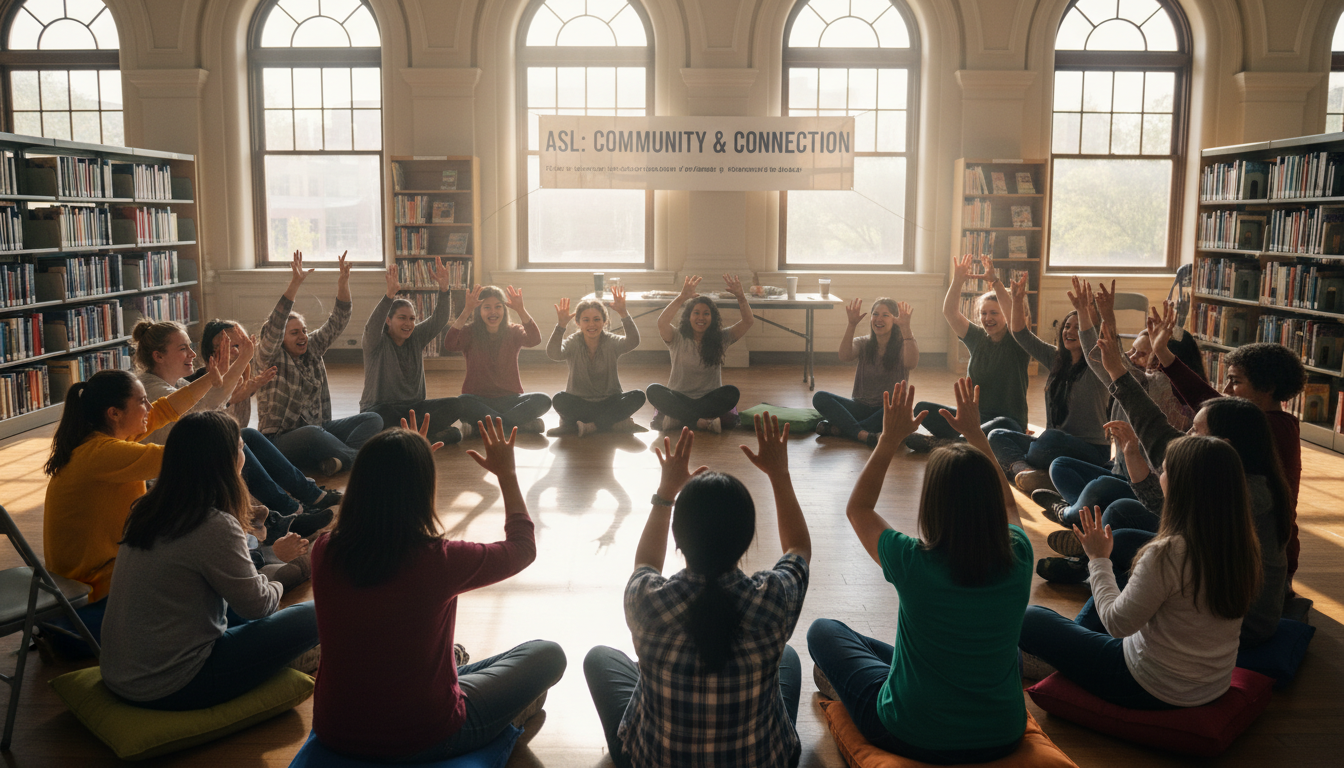
Taking allyship beyond professional walls means engaging directly with the local community. To learn how to be an ally to the Deaf community in a meaningful way, you must show up where the community gathers. Keep an eye on event calendars at the Grayslake Public Library or area community centers for Deaf-led socials, panels, and workshops. Attending these events as a learner, rather than an expert, allows you to observe cultural norms in a natural setting and build genuine relationships.
A cornerstone of this work is the principle of "nothing about us without us." This means that hearing individuals should never lead initiatives, design programs, or make policy decisions affecting the Deaf community without an equal partnership with Deaf stakeholders. If you are part of a local organization looking to improve accessibility, your first step should be consulting with Deaf leaders rather than assuming which solutions are best. This ensures that the community's collectivist needs take priority over a hearing person’s vision of what inclusion should look like.
Supporting Community inclusion programs also involves directing resources toward Deaf-owned businesses and creators. By prioritizing Deaf talent for local services, consulting, or creative projects, you help keep economic and political power within the community. True allyship often involves stepping back so Deaf voices can take the lead in their own spaces, ensuring your support facilitates their goals rather than overshadowing them.
Navigating Mistakes and the Learning Curve
The journey of learning how to be an ally to the Deaf community inevitably involves missteps. You might forget to maintain eye contact or accidentally use a sign that carries a different meaning than intended. When a member of the community corrects you, the most effective response is to listen without becoming defensive. In Deaf culture, which is deeply collectivist, feedback is usually offered to ensure the clarity and comfort of the group rather than to criticize you personally. Prioritizing the community's communication needs over your own temporary discomfort is a hallmark of genuine support.
Many hearing individuals encounter an embarrassment barrier, where the fear of making a mistake leads to total avoidance of interaction. However, avoiding a conversation is far more damaging than attempting to sign poorly. Members of the community generally respect the effort of someone trying to bridge the gap, even if the execution is imperfect. Stumbling through a sentence or needing to use a notepad shows a commitment to inclusion that silence never can. If you feel overwhelmed by the nuances of etiquette, seeking structured Deaf Awareness Training can help build the resilience needed to move past these awkward moments. By viewing mistakes as data points rather than personal failures, you remain an active participant in dismantling communication barriers.
Why Deaf Led Training is the Gold Standard for Allies
Understanding how to be an ally to the Deaf community requires recognizing that the source of your education is just as important as the content itself. When hearing people seek to learn ASL or cultural etiquette, the most ethical choice is to seek out Deaf led instruction. This practice ensures that instructional power, employment opportunities, and financial resources remain within the community rather than being co-opted by hearing individuals. A Deaf instructor does not just teach signs; they provide the lived context and cultural nuance that a hearing person cannot authentically replicate.
While mobile apps and pre recorded videos offer convenience, they lack the real time feedback essential for mastering a visual language. ASL relies heavily on non-manual markers, such as facial expressions and body shifts, which static platforms often fail to correct. Live, customized Deaf Awareness Training provides an interactive environment where students receive immediate guidance on their form and etiquette. At Easy Signing LLC, our programs in Grayslake and online are designed to bridge the gap between theory and real world application. By choosing Workplace & Professional Training led by those within the culture, you are not only gaining a skill but also actively supporting the self determination and Community inclusion programs of the people you aim to serve.
Everyday Actions: A Checklist for Hearing People
Building on your foundational knowledge of etiquette and culture, you can integrate advocacy into your daily routine. Understanding how to be an ally to the Deaf community means recognizing that small, consistent changes often have the most significant impact on accessibility. These immediate steps help shift the social environment from one of exclusion to one of active partnership.
Set captions to "on" by default on all of your devices and social media platforms. High quality captions serve as an essential backup for everyone and ensure your digital content is accessible from the start.
Master a few functional signs. Learning "please," "thank you," and "I am learning ASL" through a Deaf Awareness Training program shows a baseline level of respect and effort during initial interactions.
Offer support in public carefully. If you witness a communication barrier at a pharmacy or grocery store, ask the Deaf individual if they would like you to facilitate. Avoid taking over the conversation; prioritize their autonomy while helping to bridge the gap.
Advocate for professional access. Push for sign language interpreters at local town halls, school board meetings, or religious services. By requesting these services, you help normalize the presence of Community inclusion programs and encourage local organizations to invest in Workplace & Professional Training for their own staff.
Becoming a true ally to the Deaf community starts with a commitment to continuous learning and small, intentional actions. By focusing on effective communication and cultural respect, you can help build a more inclusive world for everyone. If you want expert help to deepen your understanding or bring these values into your workplace, our Deaf Awareness Training is an excellent resource. We are here to support your journey toward creating a space where every individual feels seen, heard, and valued.