
You can successfully learn ASL as an adult by combining formal instruction with daily immersive practice through mobile apps and local community meetups. While mastering visual grammar and facial expressions takes dedication, consistent exposure to native signers helps beginners build the recognition speed necessary for real world communication.
Many adults start their American Sign Language journey with a mobile app, only to find themselves paralyzed when attempting a real conversation. You may feel that you have missed the ideal window for language acquisition; you might also struggle to balance your practice with the demands of a professional career. However, learning ASL as an adult is less about youthful brain plasticity and more about strategic, intentional application. Beyond memorizing hand shapes, true fluency requires an understanding of facial expressions and cultural nuances that digital flashcards cannot capture. This guide offers an honest look at the adult learning process. We will explore why many popular tools fail learners, how to prioritize non-manual markers, and how to integrate ASL into your social and professional life. You will learn to set realistic goals while maintaining a deep respect for Deaf culture.
The Reality of Learning Sign Language in a Busy Adult Life

Adults often approach the decision to learn ASL as an adult with a mix of excitement and hesitation. Between professional responsibilities and family commitments, the most common concern is time. It is a myth that language acquisition is strictly reserved for the young. In fact, adult learners often possess a significant advantage: a deep, internal motivation that children lack. While children absorb language through passive exposure, adults utilize developed cognitive skills, superior focus, and a sophisticated understanding of social context to bridge communication gaps quickly.
Local Grayslake residents attending workshops and students joining live online classes from across the country share a common objective. The goal is rarely just to pass a test; it is to find connection. This might involve customized training for families to support a loved one or workplace and professional training to foster a more inclusive environment. Unlike the academic drills of childhood, adult learning focuses on practical application. You are not just memorizing a vocabulary list. You are building the capacity to engage with the Deaf community and foster meaningful inclusion. Success in ASL does not require a blank schedule; it requires a shift in perspective that prioritizes real-world interaction over perfect rote memory.
Is Learning ASL as an Adult Hard? The Honest Truth
The question of whether it is hard to learn ASL as an adult often stems from a comparison to spoken languages like Spanish or French. When you study a spoken language, you deal with the hurdles of auditory pronunciation, verb conjugations, and gendered nouns. ASL removes the vocal component entirely; there are no accents to master or tricky phonetics to mimic. Instead, the challenge shifts from your ears to your eyes.
The primary difficulty for most adults lies in the transition from auditory-sequential processing to visual-spatial processing. In English, information is delivered in a straight line of sounds. In ASL, information is delivered in a 3D space. You are using the area around your body to establish time, location, and subject. While this feels foreign at first, many adults find they have a visual learning advantage they never utilized in traditional classrooms. This spatial reasoning often comes more naturally to adults who are used to navigating complex environments or visualizing projects.
It is helpful to distinguish between manual and grammatical difficulty:
Type of Difficulty | Focus Area | Common Experience |
|---|---|---|
Manual | Hand shapes and dexterity | Usually the easiest part; improves quickly with muscle memory. |
Grammatical | Syntax and structure | The most significant shift; requires moving away from English word order. |
Manual difficulty refers to the physical dexterity required for specific signs. While some signs require fine motor skills, most beginners find this part relatively straightforward. Grammatical difficulty, however, involves unlearning English word order. ASL is not a word-for-word code for English. It is a distinct language with its own logic. Understanding that ASL often uses a topic-comment structure is the most significant hurdle. Once you stop trying to translate English and start visualizing concepts, the process becomes far more intuitive.
Why Most Apps Fail Adult Learners Who Want Real Connection
Many people trying to learn ASL as an adult start by downloading a mobile app. While these tools are convenient for building a basic vocabulary list, they often fail to bridge the gap toward actual conversational ability. A 2D screen cannot adequately replicate the 3D space required for American Sign Language. In a live setting, the distance between your hands and your body, or the precise angle of your palm, conveys specific meaning that a flat video often obscures.
Without a live instructor, it is nearly impossible to identify your own accent. In sign language, an accent is defined by hand placement and subtle movements. If your hand is slightly too high or your palm is facing the wrong direction, you might inadvertently change the meaning of a word or become unintelligible to a native signer. Furthermore, apps cannot provide real-time feedback on your facial expressions, which are the grammatical foundation of the language. To move beyond rote memorization and achieve real connection, learners need the interactive environment found in customized training for families or workplace and professional training. True inclusion requires the ability to receive and adapt to feedback in a way that software simply cannot facilitate.
Prioritize Facial Expressions and Body Language Over Hand Shapes
New learners often obsess over the physical configuration of their fingers, fearing a slightly misplaced thumb will ruin a conversation. While hand shapes are foundational, the true engine of American Sign Language is the face. In ASL, your facial expressions are not just emotional additions; they are your grammar. When you learn ASL as an adult, you must train yourself to look at the signer’s eyes rather than their hands. Looking at the face allows you to capture the grammatical signals while the hands remain clear in your peripheral vision.
Consider how a simple sentence changes meaning based solely on your eyebrows. If you sign "YOU TIRED" with neutral brows, it is a statement. Raise your eyebrows, and it transforms into a "Yes or No" question. Furrow your eyebrows, and it indicates a "WH" question, such as "Why are you tired?" This is why Deaf awareness training emphasizes non-manual markers. Our philosophy at Easy Signing LLC prioritizes communication over perfection. We encourage students to embrace expressive storytelling because a perfectly formed hand shape means little if the grammatical intent is missing from the face.
Learning ASL for Your Professional Career

Integrating sign language into professional life in Grayslake or remote work environments provides a distinct competitive advantage. For healthcare providers, the ability to greet a Deaf patient, ask their name, or sign "I am getting an interpreter" transforms the patient experience. These small gestures reduce medical anxiety and demonstrate a commitment to Deaf awareness training that goes beyond basic compliance. In a clinical setting, clarity and comfort are paramount; even introductory signs can bridge the gap during the critical first minutes of an appointment before a professional interpreter arrives.
In the corporate world, inclusive leadership is becoming a standard expectation rather than an elective skill. A manager who uses basic signs during a remote video call or a team meeting signals that every employee’s communication needs are valued. You do not need to achieve 100 percent fluency to make a significant impact on office culture. By pursuing workplace and professional training, you gain the tools to facilitate more accessible interactions and foster a genuine sense of belonging. When you learn ASL as an adult professional, you are not just adding a line to your resume; you are actively dismantling barriers in the local business community and the global digital workforce. This proactive approach to inclusion often speaks louder than the signs themselves.
The Social Connection: Learning ASL as a Family or Community
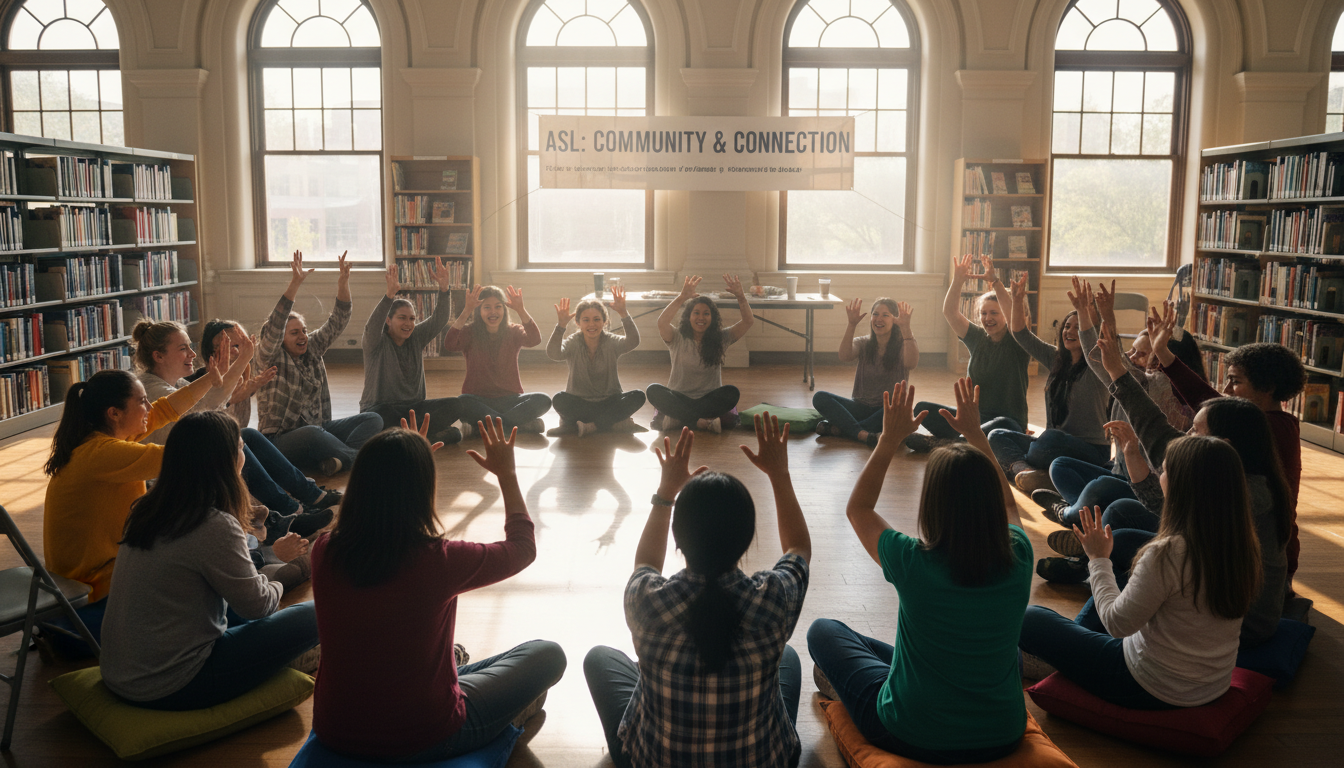
Beyond the office, the drive to learn ASL as an adult often begins at the kitchen table. When you engage in customized training for families, you transform a solitary study habit into a shared household language. Adults are uniquely positioned to lead this journey by integrating signs into daily routines, such as signing during meals or morning greetings. This approach turns family members into immediate practice partners, ensuring that new signs are used in context rather than forgotten in a notebook.
In the Grayslake area, social connection extends to community centers and faith-based programs. Joining these local groups provides a support network that eliminates the isolation often felt during solo study. Many religious institutions now offer Deaf awareness training to ensure their congregants can welcome every member of the community. By learning alongside neighbors, you create a culture of accessibility that benefits the entire region. Moving from individual study to community practice shifts the focus from merely memorizing signs to building lasting bridges between hearing and Deaf individuals.
How Long Does It Take to Learn ASL? Setting Realistic Goals
Determining the timeline to learn ASL as an adult depends on your specific goals. Most learners master the manual alphabet and essential greetings within two to four weeks. Transitioning to basic conversational competence, such as discussing daily routines during customized training for families, typically requires three to six months of focused effort. Achieving professional fluency, the level necessary for complex medical or legal interactions, is a commitment spanning multiple years of deep cultural immersion. For those pursuing workplace and professional training, progress is measured by the ability to navigate specific vocational scenarios rather than total vocabulary count.
Progress is possible without a massive time commitment if you prioritize consistency over intensity. A manageable schedule for a busy adult includes:
Daily (15 mins): Practice fingerspelling or review vocabulary during a break to build muscle memory.
Weekly (60 mins): Attend a live class to receive real-time correction on hand placement and grammar.
Monthly: Participate in a Deaf awareness training workshop or community social event.
This rhythmic approach builds the necessary visual stamina and spatial awareness without overwhelming your existing professional or personal responsibilities.
Respecting Deaf Culture While You Learn
Approaching American Sign Language as a mere utility ignores the rich history and social norms that give the language its meaning. To truly learn ASL as an adult, you must recognize that you are a guest in a culture with its own unique values and etiquette. Seeking instruction from Deaf or native level teachers is essential; they provide the cultural context that a textbook or app cannot. These educators teach you the nuances of "Deaf Heart," a term describing an individual’s genuine empathy, respect, and commitment to the Deaf community.
Cultural sensitivity is just as important as the signs themselves. For example, understanding how to properly enter a conversation or get a signer’s attention without causing offense is vital for real world interaction. By participating in Deaf awareness training, you move beyond technical proficiency toward authentic allyship. This ethical approach ensures that your journey toward inclusion is rooted in respect for the people who own the language, fostering deeper connections that go far beyond basic hand shapes.
Learning ASL as an adult requires patience and a steady routine, but the rewards of connecting with others are well worth the effort. By focusing on practical signs and consistent practice, you can build a solid foundation at your own pace. If you want expert help to accelerate your progress or involve your household, we offer tailored guidance. Our Personal & Family ASL program provides a supportive environment to help you reach your goals. Together, we can make sign language a natural part of your daily life.


